A Waikīkī room with a $300 nightly rate rarely costs $300. Add a resort fee of $50 to $60, which is now the norm on the beachfront, then roughly 18.7 per cent in state and county taxes on both, and a car at the Hilton Hawaiian Village costs another $72.25 a night just to park. That’s the first thing to understand when you’re deciding where to stay in Oahu: the headline rate is only the start. The second is that the island’s holiday-rental rules shape where you can legally stay far more than most visitors realise. Below you’ll find every main base on the island compared, from Waikīkī to Ko Olina, the North Shore and Kailua, with the 2026 resort fees and parking charges we could confirm, worked examples of the true nightly price in different seasons, and a straight answer on which area suits which kind of trip.
The short answer: stay in Waikīkī if it’s your first visit, you don’t want to drive, or you’re here for less than a week. Choose Ko Olina for a resort holiday with small children, the North Shore for surf and a slower pace, and Kailua only if you can find a legal rental. Whatever you book, compare the all-in price, not the advertised rate.
Where to stay in Oahu: the areas compared
Oʻahu is small enough to drive around in a long day, but traffic on the H-1 and the Pali and Likelike highways makes where you sleep matter. Staying in the wrong place can mean two hours a day in a car. The island’s accommodation is also unusually concentrated: most hotel rooms are in Waikīkī, with smaller clusters at Ko Olina on the west side and Turtle Bay on the North Shore, and very little in between.
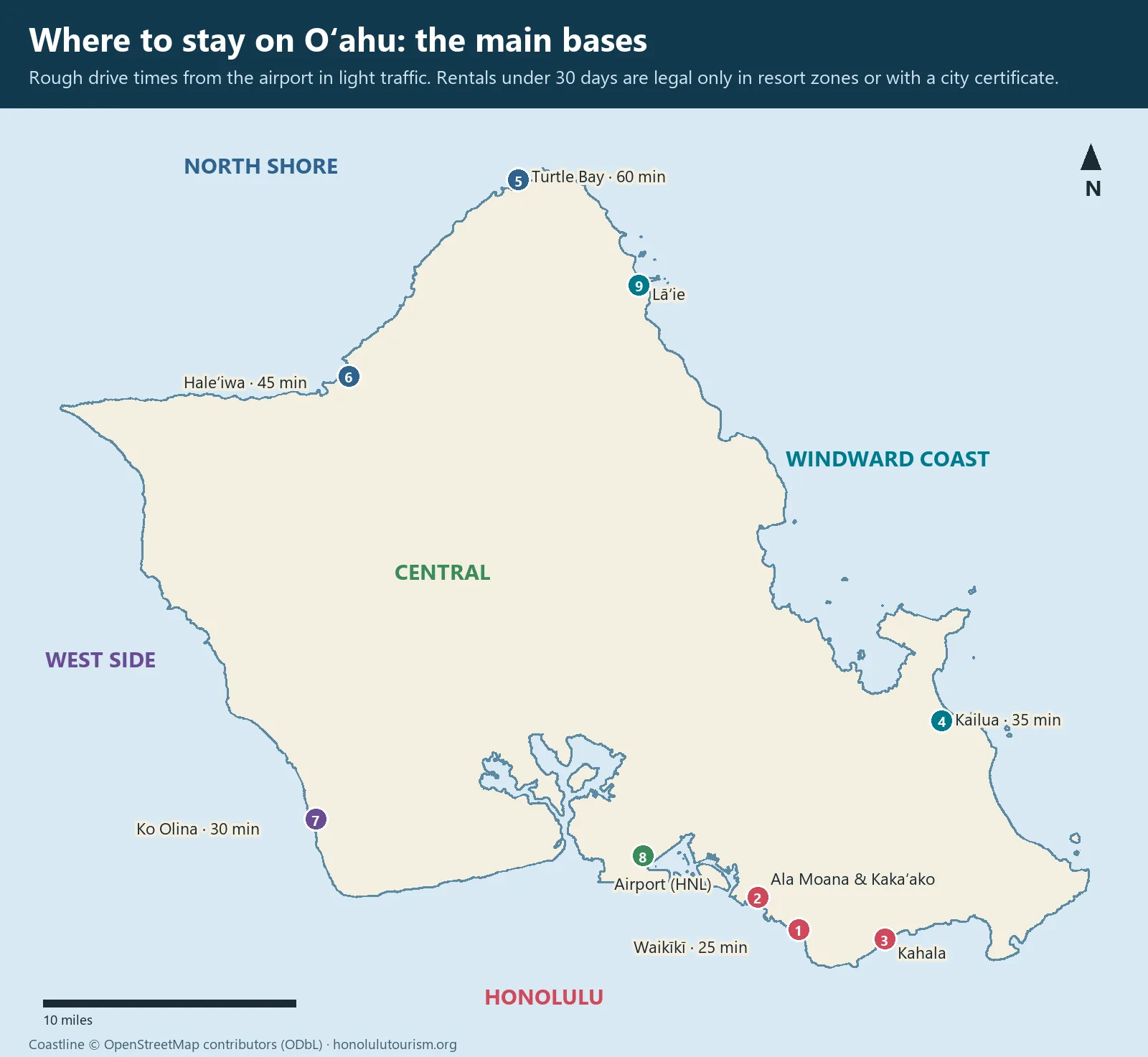
| Area | Best for | Beach | Need a car? | Stays under 30 days legal? | From the airport | Main downside |
|---|---|---|---|---|---|---|
| Waikīkī | First-timers, car-free trips, nightlife | On the doorstep | No | Yes (resort zone) | About 25 minutes | Crowds, resort fees, parking costs |
| Ala Moana and Kakaʻako | Shopping, food, local Honolulu | Ala Moana Beach Park | No | Hotels only; condos need 30+ days | About 20 minutes | Few hotels |
| Kahala | Quiet luxury near the city | Kahala’s small beaches | Helpful | Hotel only | About 30 minutes | Very limited choice |
| Ko Olina | Families, resort stays, calm water | Four sheltered lagoons | Yes | Yes (resort zone) | About 30 minutes | Far from Honolulu at rush hour |
| North Shore and Turtle Bay | Surf, slow pace, nature | Winter surf, summer snorkelling | Yes | Turtle Bay only | About an hour | Few legal options |
| Lāʻie | Polynesian Cultural Center, quiet | Local beaches | Yes | Hotel only | An hour or more | Very quiet, limited dining |
| Kailua | Beach-town feel, kayaking | Kailua and Lanikai | Helpful | Only with a city certificate | About 35 minutes | Legal rentals are scarce |
Drive times are rough figures for light traffic. At weekday rush hours, roughly 6am to 9am and 3pm to 6pm, double them, especially on the H-1 between the airport and Ko Olina.
The holiday-rental rules you need to know
This is the part most guides skip, and it can ruin a trip. Honolulu has strict rules on short-term rentals, and in most residential neighbourhoods it is illegal to rent a house or apartment for fewer than 30 days. The city tried to raise that minimum to 90 days in 2022, but a federal court blocked the change, so the 30-day rule is what applies in 2026.
Stays of under 30 days are legal in three kinds of place:
- Resort-zoned areas: Waikīkī, Ko Olina and Turtle Bay, where condos and hotels can rent by the night.
- Properties with a Nonconforming Use Certificate: roughly 800 homes across the island that were licensed before the rules tightened. Legitimate owners display the certificate number in their listing.
- Hotels and some older hotel-condo buildings that have always operated as lodging.
In practice, that means a week-long rental in Kailua, Haleʻiwa or Kakaʻako is only legal if it has a certificate. If a listing doesn’t show one, ask. Illegal rentals do get shut down, and if that happens before or during your stay, you have little protection. The rules change regularly, so check the city’s current position before you book anything outside a resort area.
What a room really costs
Three extra charges turn a hotel’s headline rate into your real bill.
- Resort fees. Most beachfront Waikīkī hotels now charge a mandatory daily resort fee of roughly $50 to $60, supposedly covering things like Wi-Fi, beach towels and a cultural activity. You pay it whether you use them or not.
- Taxes. Hawaiʻi’s state lodging tax rose to 11 per cent in January 2026 with the new Green Fee. Oʻahu adds a 3 per cent county lodging tax, and the general excise tax adds about 4.7 per cent more. Together that’s roughly 18.7 per cent, charged on the room rate and the resort fee.
- Parking. Waikīkī hotel parking averages around $44 a night, and valet usually adds about $10. At the Hilton Hawaiian Village it’s $72.25 to self-park and $93.19 for valet.
Here’s how that adds up, using the state’s average hotel rates for 2025 and a typical $55 resort fee. These are statewide averages, so a beachfront Waikīkī room will usually cost more, and a room on a Waikīkī back street less.
| Month (2025) | Average room rate | Plus $55 resort fee | Plus ~18.7% tax | Before parking |
|---|---|---|---|---|
| February | $379 | $434 | $81 | About $515 |
| April | $366 | $421 | $79 | About $500 |
| September | $315 | $370 | $69 | About $439 |
| October | $322 | $377 | $70 | About $448 |
| November | $345 | $400 | $75 | About $475 |
What do resort fees actually buy? Usually Wi-Fi, beach chairs or towels, a daily cultural activity such as a lei-making or ʻukulele class, sometimes a welcome drink or a discount at the hotel’s restaurants. Some are genuinely useful; many duplicate things that used to be included in the room rate. A few Waikīkī hotels still don’t charge them, and some hotel loyalty programmes waive them on reward nights, so check before you book. If a resort fee is listed as including parking, it’s worth doing the sums, because that can make an apparently expensive hotel cheaper than its neighbours for anyone with a car.
One more thing: the taxes are charged on the resort fee as well as the room, so a $55 fee really costs you about $65 a night. Over a week, that’s more than $450 on fees and tax alone before you’ve parked a car or ordered a drink.
Add $44 to $93 a night for parking if you have a car. That’s why the most common money-saving move on Oʻahu is not a cheaper hotel but a shorter car hire: rent for the two or three days you’ll actually drive around the island, and go car-free the rest of the time.
The areas, one by one
1. Waikīkī
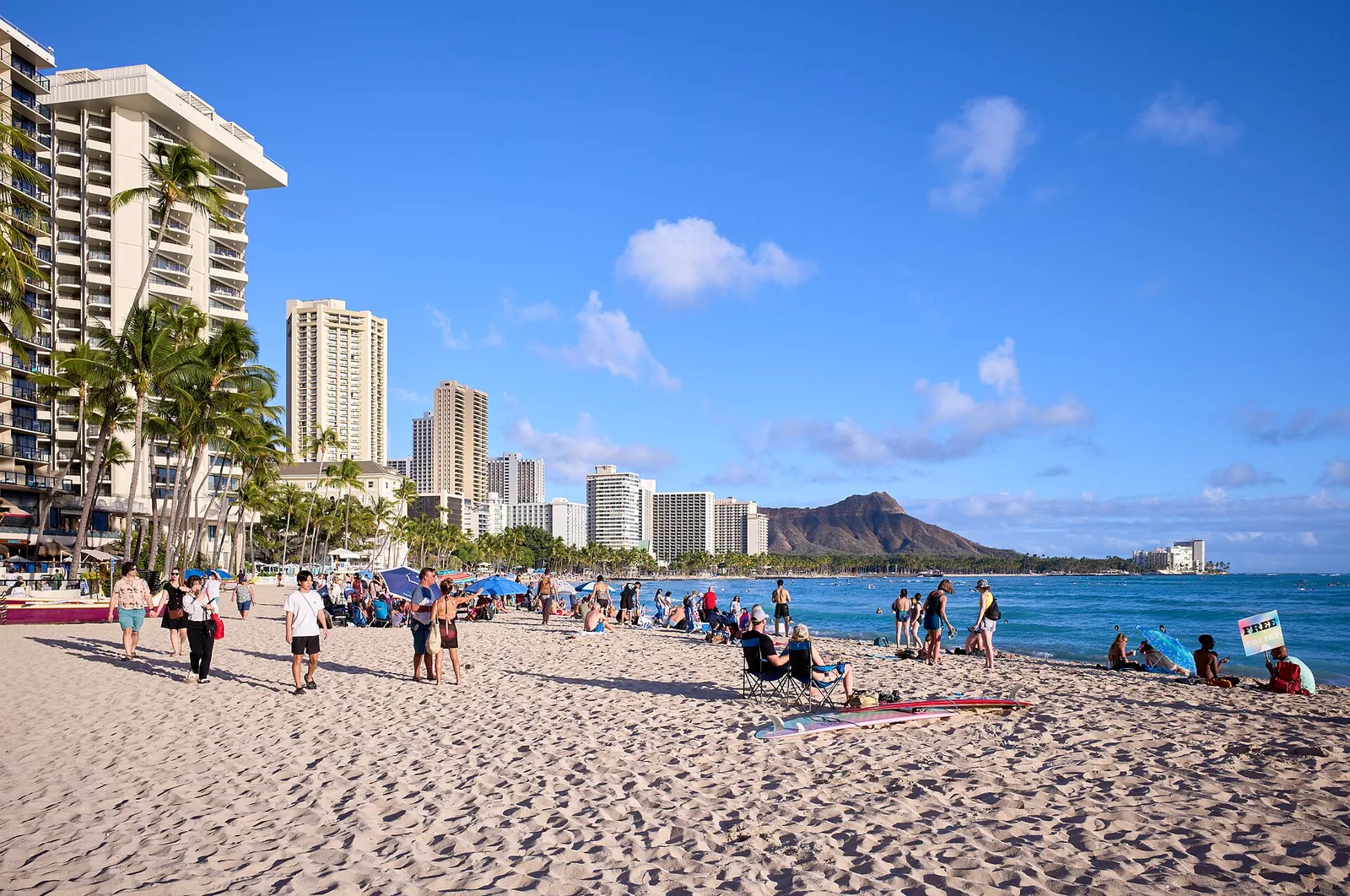
Waikīkī is where most visitors stay, and for a first trip it’s usually the right call. It has the widest choice of hotels at every price, the gentlest swimming beach on the south shore, the best bus connections on the island and enough restaurants, bars and free entertainment to fill a week without a car. The airport is about 25 minutes away, and the W Line bus now runs straight from the airport’s Skyline station into Waikīkī for $3.25.
The downsides are real. Waikīkī is crowded, noisy in places and expensive once fees are added, and the beach between 10am and 4pm can be shoulder to shoulder. But it’s also compact: nowhere is more than about 15 minutes’ walk from the sand. For the beach itself, section by section, see our guide to Waikīkī Beach.
Where you stay within Waikīkī matters more than people expect.
- The ʻEwa end, around the Hilton Hawaiian Village and Fort DeRussy, has the widest, calmest beach and the Friday fireworks, and it’s a little quieter than the centre.
- Central Waikīkī, along Kalākaua Avenue between the Royal Hawaiian and Kūhiō Beach, puts you in the middle of everything: surf lessons, shops, restaurants and the Saturday hula show. It’s also the busiest.
- The Diamond Head end, near Kapiʻolani Park, is calmer and more residential, with the zoo, aquarium and Sans Souci beach on the doorstep.
- The back streets, along Kūhiō Avenue and the Ala Wai Canal, are where the better-value hotels are, many without ocean views but within a 10-minute walk of the beach. Rooms facing the canal often get mountain views and sunsets.
From here: Diamond Head is ten minutes away by car, or on Routes 2, 2L and 23, with reservations up to 30 days ahead at $5 a person. Pearl Harbor is about an hour on Route 42. Hanauma Bay has no direct bus, but Roberts Hawaiʻi sells entry plus an electric bus from Waikīkī for about $65. The North Shore and the windward coast are day trips by car or tour, and Ala Moana Center and downtown are a short bus ride away.
Cost: resort fees typically $50–60 a night; parking about $44–93 · Book: 3–6 months ahead for holidays · Bus: W Line from the airport; Routes 2, 13 and 42 · Allow: ideal for stays of up to a week
2. Ala Moana and Kakaʻako
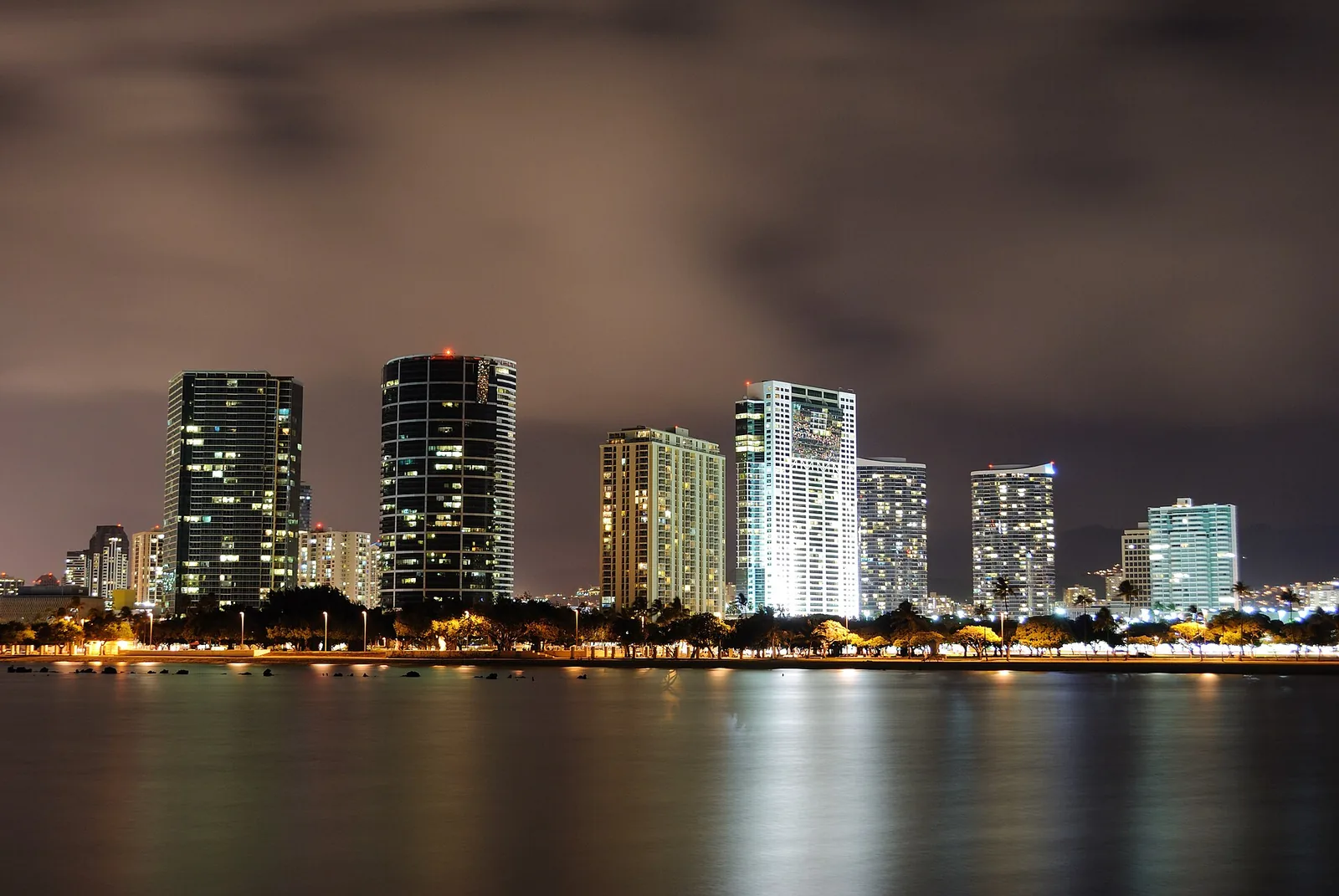
Just west of Waikīkī, Ala Moana is home to Hawaiʻi’s largest shopping centre, open 10am to 8pm, and Ala Moana Beach Park, where much of Honolulu goes to swim. Next door, Kakaʻako has gone from warehouses to glass towers in little more than a decade, with street murals, craft breweries, food halls and some of the city’s best restaurants. It feels like modern Honolulu rather than a resort.
The catch is accommodation. There are only a handful of hotels here, and because Kakaʻako isn’t resort-zoned, the many condos can only be rented for 30 days or more. It suits longer stays, repeat visitors and anyone who wants to live like a local for a month. For a short trip, Waikīkī is 10 minutes away by bus.
From here: Ala Moana Beach Park and Magic Island are across the road, with calm, lifeguarded water inside the reef. Downtown and Chinatown are ten minutes away, including ʻIolani Palace, where tours are sold online only at $28 to $34, and First Friday, when Chinatown’s galleries and bars stay open from 5pm to 9pm on the first Friday of each month. Waikīkī is a short walk or bus ride east.
Cost: hotels similar to mid-range Waikīkī; monthly condos vary widely · Book: check rental legality · Bus: many routes via Ala Moana Center · Allow: best for stays of a month or more
3. Kahala
East of Diamond Head, Kahala is Honolulu’s most exclusive residential neighbourhood, with big houses, quiet streets and one landmark luxury hotel on the beach. It’s ten minutes from Waikīkī by car but feels a world away, which is the point. If you want the calm of a resort and easy access to the city, and budget isn’t a concern, it’s worth a look.
There’s little else here in the way of accommodation, and the residential streets are not resort-zoned, so short holiday rentals are off the table. You’ll want a car or taxis to get around.
From here: Diamond Head is five minutes away, and the Saturday farmers market at Kapiʻolani Community College, from 7:30am to 11am on the crater’s slope, is closer still. Hanauma Bay and the southeast coast, with the two-mile Makapuʻu Lighthouse Trail and the Hālona Blowhole, are an easy drive east. Waikīkī’s restaurants are ten minutes in the other direction.
Cost: luxury rates · Book: direct with the hotel · Bus: limited · Allow: a short, quiet stay
4. Ko Olina
On Oʻahu’s west side, about 30 minutes from the airport, Ko Olina is a purpose-built resort area of four man-made lagoons, a marina, a golf course and a cluster of big resorts, including Disney’s Aulani and a Four Seasons, plus several timeshare and condo properties. The lagoons are protected by rock breakwaters, making them some of the calmest swimming on the island, and ideal for small children. It’s also resort-zoned, so condo rentals by the night are legal here.
Ko Olina’s great strength is also its weakness: it’s self-contained. It’s a long way from Honolulu, Waikīkī, the North Shore and the windward coast, and the H-1 heading into town is one of the worst traffic corridors on the island at rush hour. Plan on a car, and on staying put for most of your trip. Parking at the Four Seasons is valet only, at about $45 to $50 a night. The lagoons themselves are open to the public, with free parking in four small lagoon car parks between sunrise and sunset.
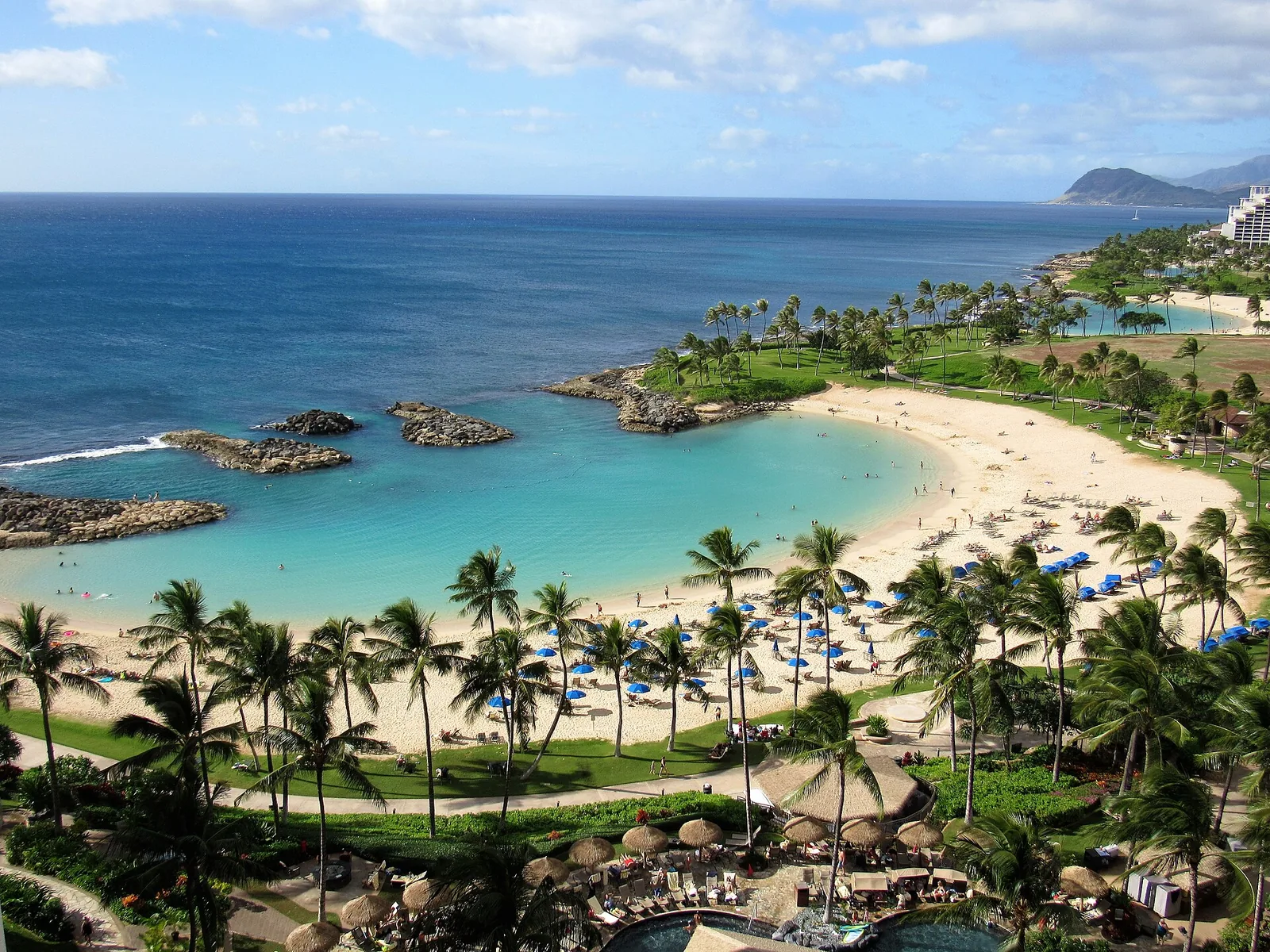
From here: the four lagoons are the main attraction, linked by a paved beach path, and the sunsets over the open ocean are among the best on the island. Kapolei’s shops and supermarkets are a short drive inland, and Pearl Harbor is about half an hour away outside rush hour. Much of the coast further north is off limits for now: since Hurricane Lowell, Farrington Highway has been closed through Nānākuli and Mākaha.
Cost: high; resort fees and valet parking extra · Book: 3–6 months ahead for school holidays · Bus: impractical · Allow: best for a resort-based week with children
5. The North Shore and Turtle Bay
The North Shore is Oʻahu at its most relaxed: surf towns, shrimp trucks, sea turtles and, from November to March, the biggest waves in the world breaking at Pipeline and Waimea Bay. In summer the same beaches go flat and become excellent for snorkelling. It’s about an hour from the airport and an hour or more from Waikīkī.
Staying here is harder than it looks. Turtle Bay, on the island’s northern tip, is the only big resort on the North Shore and the only resort-zoned area, so it’s the one place where short stays are straightforward. Elsewhere, in Haleʻiwa and along Sunset Beach, most holiday rentals are illegal unless they hold a city certificate. Turtle Bay itself sits on its own point, with trails, a sheltered swimming cove at Kuilima and horse riding, and it books up early for the winter surf season.
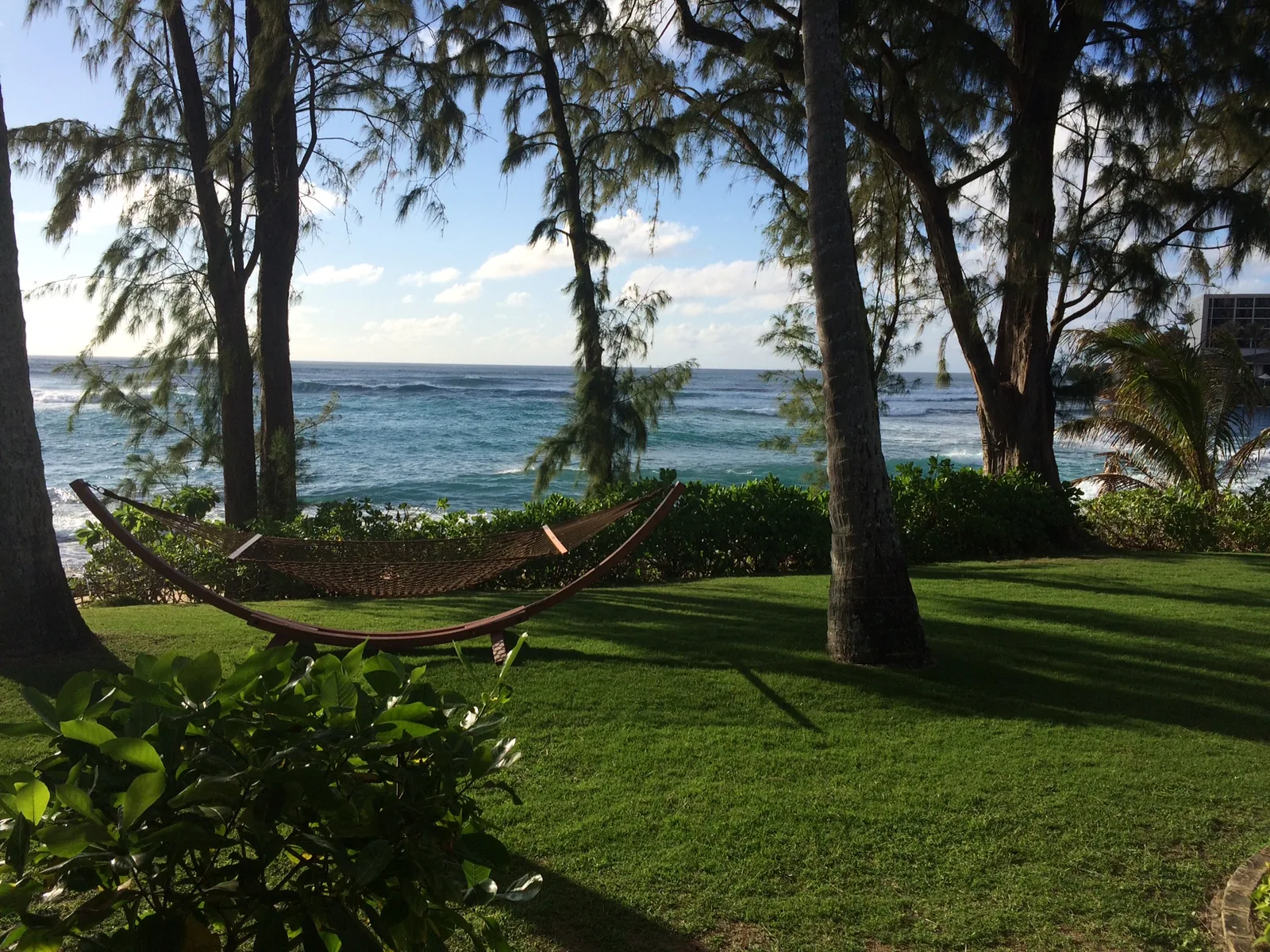
From here: Waimea Bay, with lifeguards from 8am to 6:30pm, and Waimea Valley, $26 and open Tuesday to Sunday from 9am to 4pm, are a short drive west. Haleʻiwa has the island’s best-known shave ice at Matsumoto’s, open 10am to 6pm, and a farmers market on Thursday afternoons from 3pm to 7pm. In summer, Sharks Cove is the snorkelling spot; in winter, watch Pipeline from the sand and stay out of the water.
Cost: resort rates · Book: early for November–March · Bus: Route 60, slow · Allow: 3–4 nights, ideally after a few days in Honolulu
6. Lāʻie
On the windward side between the North Shore and Kāneʻohe, Lāʻie is a small, quiet town built around Brigham Young University–Hawaii and the Polynesian Cultural Center, which recreates six Polynesian villages and is consistently rated Oʻahu’s top paid attraction. There’s a mid-range hotel next to the centre, and it’s a sensible base if the Cultural Center and the North Shore are your priorities.
Lāʻie is a Latter-day Saint community and it’s quiet in the evenings. The Cultural Center is closed on Sundays and Wednesdays, and villages entry costs $94.95, with the Aliʻi Lūʻau package at $197.95. The coach from Waikīkī is $28 if you’re not staying here.
From here: Kualoa Ranch, about 20 minutes south, runs movie-site and jungle tours from $59.95 and UTV rides from $149.95, and the UTVs sell out weeks ahead. The North Shore’s beaches are about 15 minutes the other way, and Turtle Bay’s coastal trails are close by.
Cost: mid-range · Hours: Cultural Center 12pm–9pm, closed Sunday and Wednesday · Bus: Route 60 · Allow: 1–2 nights
7. Kailua
Kailua is the windward beach town many visitors fall in love with: a long, soft white-sand beach, kayak trips to the Mokulua islands, farmers’ markets and a relaxed small-town feel, 35 minutes from the airport over the mountains. Next door, Lanikai is one of the most photographed beaches in Hawaiʻi.
The problem is that Kailua has almost no hotels, and it isn’t resort-zoned. Stays under 30 days are only legal in the small number of homes with a Nonconforming Use Certificate, and many listings you’ll see online don’t have one. If you want Kailua, the realistic options are a certified rental, a longer stay of a month or more, or staying in Waikīkī and visiting for the day on Route 67, which runs between Ala Moana and Kailua.
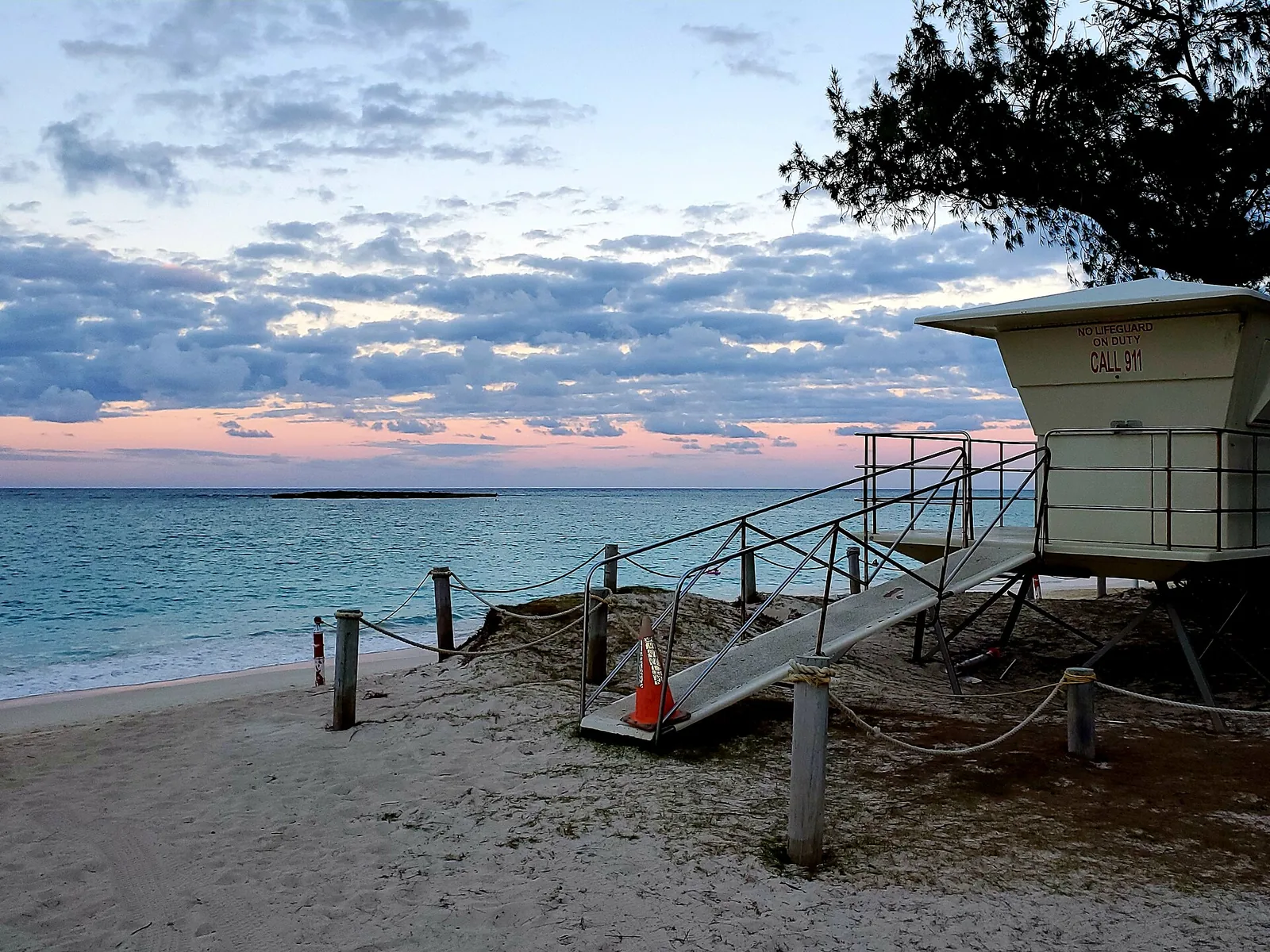
From here: Kailua Beach Adventures rents single kayaks for $74 for a half day. Landing on Moku Nui, the larger of the Mokulua islands, needs a $3 state permit per person and is allowed Monday to Saturday only; Moku Iki is always off limits. In Kāneʻohe, the Byodo-In Temple costs $10 and opens from 8:30am to 4:30pm, and Hoʻomaluhia Botanical Garden is free, open 9am to 4pm and closed on Thursdays.
Cost: certified rentals vary · Book: check for a certificate number · Bus: Route 67 from Ala Moana · Allow: a day trip, or a month
Hotels, condos and holiday rentals
Most visitors choose between three kinds of accommodation, and each has trade-offs beyond the headline price.
Hotels
Hotels give you daily housekeeping, a front desk and usually a pool and a beach towel service. They also tend to charge the highest resort fees and parking rates. In Waikīkī they range from landmark beachfront properties to plain, good-value towers on the back streets, and the gap between the two is often bigger than the gap between seasons. If you’ll spend your days out exploring, a simple room a few blocks back is usually the better deal.
Condo-hotels and vacation clubs
Many Waikīkī and Ko Olina towers mix hotel rooms with privately owned condos, rented by the night through the building’s front desk or a management company. Because these buildings are resort-zoned, short stays are legal, and you usually get a kitchen or kitchenette, which makes a real difference to a family’s food bill. Timeshare and vacation-club properties at Ko Olina and in Waikīkī work in a similar way. If you book one, expect to be offered a sales presentation, and feel free to decline it.
Holiday rentals
Houses and apartments outside the resort zones can only be rented for 30 days or more unless they hold a city Nonconforming Use Certificate. Anyone renting out accommodation in Hawaiʻi also has to register for the state lodging tax and show their registration number in adverts, so a missing number is another warning sign. Watch for cleaning and service fees, which can add a surprising amount to a short stay, and read the cancellation terms carefully.
Named hotels: fees and parking in 2026
These are the resort fees and parking charges we could confirm for some of the best-known hotels. Fees change often, so always check the total price, including fees and taxes, before you book.
| Hotel | Area | Resort fee (2026) | Parking | Walk to the sand |
|---|---|---|---|---|
| Royal Hawaiian | Central Waikīkī | $52 a night | Check with hotel | On the beach |
| Sheraton Waikiki | Central Waikīkī | About $61 a night | $55 a night | On the beach |
| Hilton Hawaiian Village | ʻEwa end, Waikīkī | About $59 a night | $72.25 self-park, $93.19 valet | On the beach |
| Outrigger Waikiki Beachcomber | Central Waikīkī | About $47 a night | Check with hotel | Across Kalākaua Avenue, 2 minutes |
| Moana Surfrider | Central Waikīkī | Check with hotel | Check with hotel | On the beach |
| Four Seasons Oahu at Ko Olina | Ko Olina | Check with hotel | Valet only, about $45–50 | On the lagoon |
The classic beachfront hotels
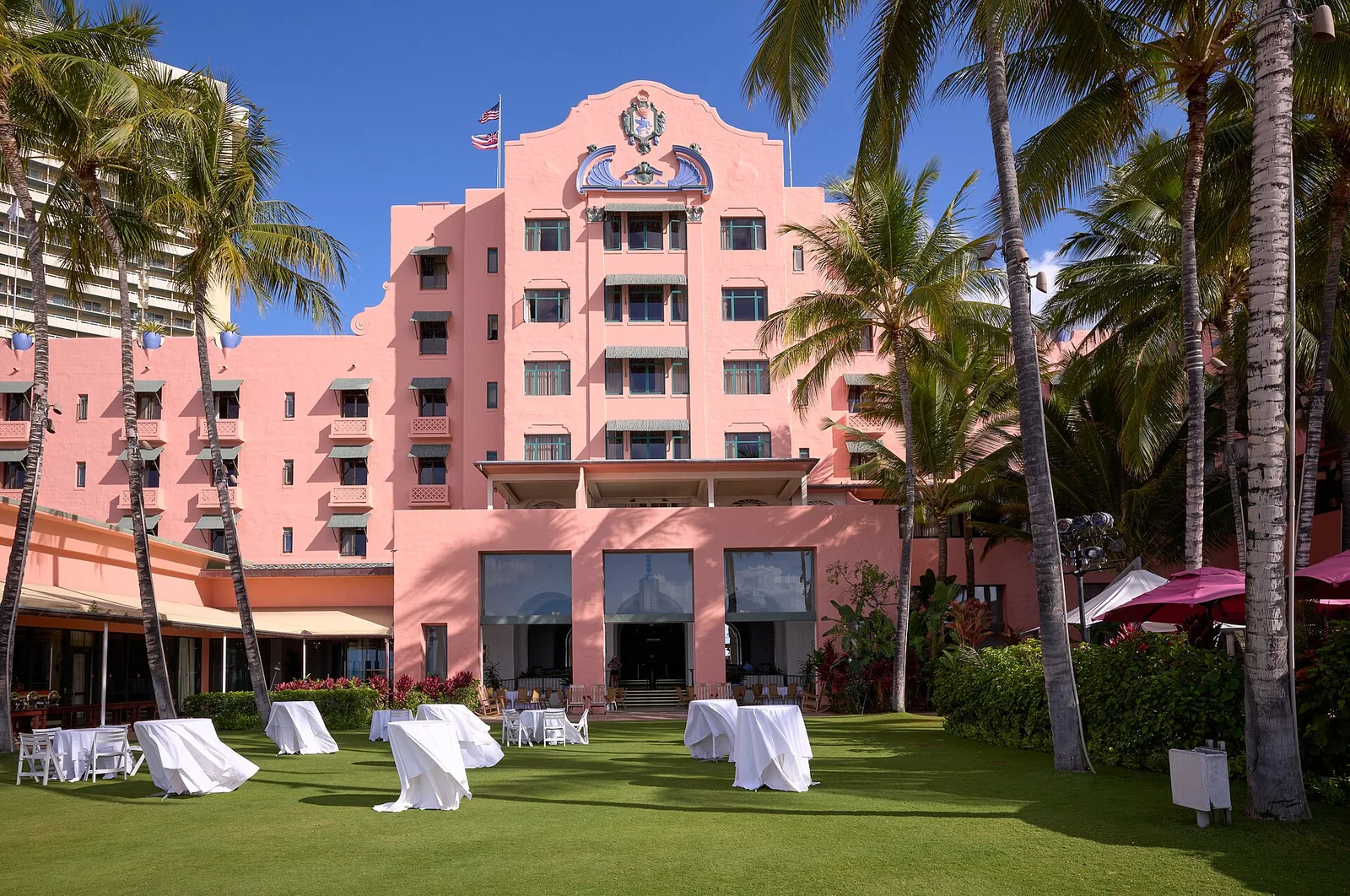
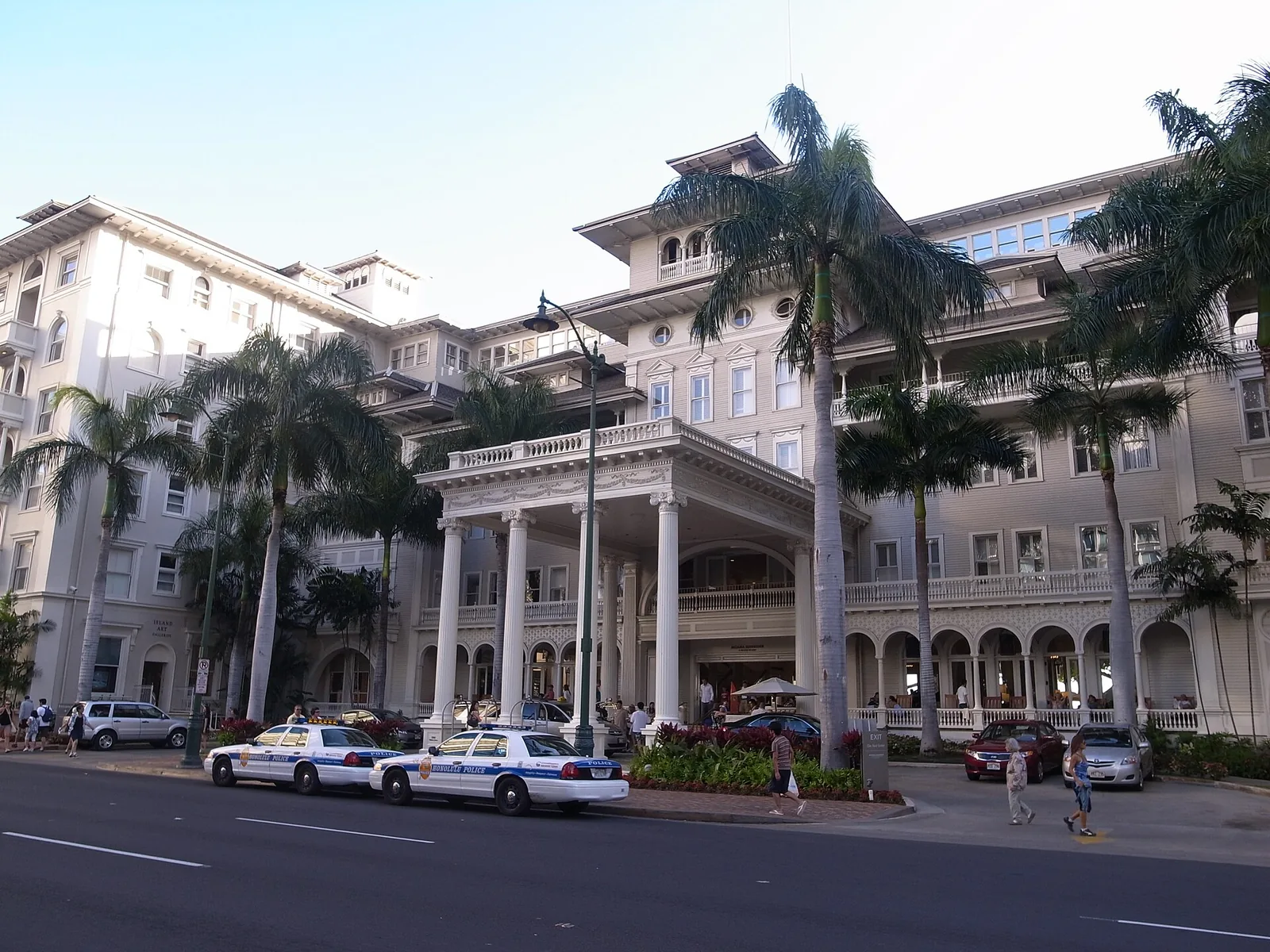
Two historic hotels define Waikīkī’s image. The Moana Surfrider opened in 1901 as Waikīkī’s first hotel, and its white colonial front and banyan courtyard still set the tone for the whole beach. The Royal Hawaiian, the “Pink Palace”, opened in 1927 for passengers arriving on Matson’s ocean liners. Staying at either puts you right on the sand in the middle of Waikīkī, at a price. Even if you stay elsewhere, their beachfront bars are open to everyone.
The big resort at the ʻEwa end
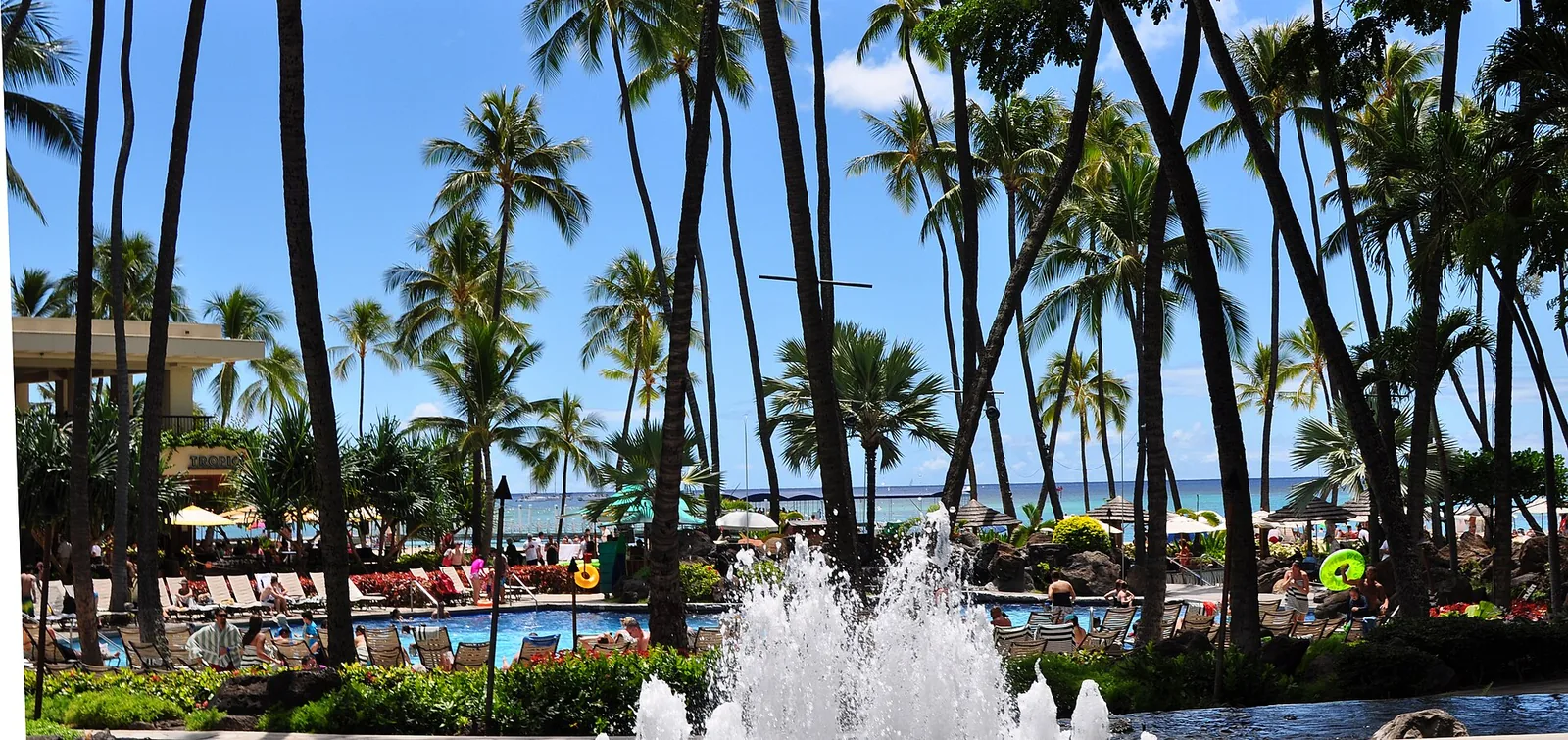
The Hilton Hawaiian Village is almost a town in itself, with several towers, pools, restaurants, a lagoon and even a small colony of penguins in its courtyard. It fronts the calmest, widest section of Waikīkī beach and hosts the Friday fireworks. It’s a good choice for families who want everything in one place, but it’s also one of the most expensive places on the island to park.
Where to stay in Oahu by type of trip
First-time visitors
Stay in Waikīkī. You’ll be able to walk to the beach, take the bus to Pearl Harbor and downtown, join a tour to the North Shore and rent a car for just the days you need it. If you have more than a week, split your stay: most of it in Waikīkī, then three or four nights on the North Shore or at Ko Olina.
Families with young children
Ko Olina’s calm lagoons and big resort pools are hard to beat for small children, and Aulani sits right on one of them. In Waikīkī, the Hilton Hawaiian Village and the Diamond Head end near the zoo and aquarium work well. Look for rooms with a kitchenette or a condo in a resort-zoned building to save on eating out.
Couples and honeymoons
For a classic Waikīkī stay, the beachfront hotels in the centre of the strip have the history and the views. For privacy, Kahala and Ko Olina are quieter, and Turtle Bay offers a very different, more rural side of the island, especially in summer when the North Shore is calm.
Surfers
If you’ve come to surf big waves or watch them, stay on the North Shore between November and March, ideally at Turtle Bay or in a certified rental near Sunset Beach. If you’re learning, stay in Waikīkī, where the waves are gentle all year and the surf schools are on the beach.
Where to stay in Oahu on a budget
Look along Kūhiō Avenue and the Ala Wai side of Waikīkī, where hotels are cheaper, resort fees are often lower, and you’re still a short walk from the beach. Waikīkī also has a few hostels, mostly near Kapiʻolani Park. Travel in September, May or early December, when rates are lowest, and skip the car: TheBus and Skyline reach most of the island’s highlights, and a HOLO card caps fares at $7.50 a day. Budget travellers can get by on around $149 per person per day.
Without a car
Waikīkī is the only area where a car-free stay is easy. From there, TheBus and Skyline reach Pearl Harbor, Ala Moana, downtown, Diamond Head and most major beaches, and Route 60 runs to the North Shore. Ko Olina, Kahala and the North Shore all need a car.
Longer stays
If you’re staying a month or more, the rules open up. Monthly rentals are legal across the island, so Kailua, Kakaʻako, Mānoa and the North Shore become realistic options, often at lower nightly rates than a hotel.
Sample stays: how to split a week or more
Oʻahu rewards splitting your nights between two bases, but only if the second base adds something the first can’t. These are the combinations that work best.
Five nights: Waikīkī only
With five nights, don’t move. Stay in Waikīkī, spend a day at Pearl Harbor and downtown, a morning at Diamond Head and a day at Hanauma Bay and the southeast coast, then rent a car for one full circle-island day via the windward coast and the North Shore. Book the car for 24 hours only and pick it up in Waikīkī.
Seven nights: Waikīkī plus the North Shore
Spend four or five nights in Waikīkī, then drive up the windward coast, stopping in Kailua, at the Byodo-In Temple and at Kualoa, to spend two or three nights at Turtle Bay. Return along the North Shore via Haleʻiwa and the central plain to the airport. You’ll only need the car for the last three days.
Ten nights: Waikīkī, the North Shore and Ko Olina
Add a final few nights at Ko Olina to finish with a slow resort stay close to the airport. Or, if it’s your first trip to Hawaiʻi, spend those nights on a neighbour island instead: Maui for Haleakalā and the whales, or Hawaiʻi Island for the volcano. Midweek interisland flights are usually cheaper than weekend ones.
A month or more
For long stays, a monthly rental in a residential neighbourhood becomes legal and often cheaper than a hotel. Mānoa and Kaimukī put you close to the university, Diamond Head and good local restaurants; Kailua gives you the windward beaches; the North Shore suits surfers in winter. Book early for the winter months, when long-stay rentals are in demand.
Booking tips that save money
- Compare the total. Federal rules introduced in 2025 require hotels and booking sites to include mandatory resort fees in the price they show you, but taxes and parking usually come on top. Check the final total, not the first number you see.
- Rent a car only when you need it. Skipping two or three nights of hotel parking can save $150 or more.
- Know your view categories. “Oceanfront” means facing the sea directly; “ocean view” can mean a glimpse between buildings; “partial ocean view” often means a sliver from the balcony. Mountain and city views are often cheaper and, facing the Koʻolau at sunset, sometimes better.
- Travel in the shoulder months. September, May and early December offer the best rates and the fewest crowds. See our guide to the best time to visit Hawaii for month-by-month prices.
- Check the rental’s legality. Outside Waikīkī, Ko Olina and Turtle Bay, a stay under 30 days needs a city certificate. No number, no booking.
- Consider splitting your stay. A few nights in Waikīkī followed by a few on the North Shore or at Ko Olina lets you see more of the island without long daily drives.
Staying safe, and being a good neighbour
Wherever you stay, the ocean is the biggest risk. Drowning is the leading cause of injury death among visitors to Hawaiʻi, and it often happens to people swimming near their hotel or rental, alone and far from a lifeguard. If you have children or weak swimmers in your group, choose a base near a lifeguarded beach, and on the North Shore treat winter surf as something to watch, not swim in.
Car break-ins are common at beach car parks and outside holiday rentals, so leave nothing in view and keep valuables out of the car altogether. In residential areas such as Kailua, Lanikai and the North Shore, you’re staying among people who live there all year: keep the noise down at night, park only in legal spaces, and never block driveways or narrow lanes.
When to book your room
For the Christmas and New Year holidays, spring break and the July school holidays, book three to six months ahead; the best-value rooms in Waikīkī and the family suites at Ko Olina go first. For September, May or early November, a month or two is usually enough, and last-minute deals do appear.
Watch for events that squeeze a particular area. In December 2026, the Pearl Harbor 85th anniversary on the 7th, the Pipe Masters waiting period from 8 to 20 December and the Honolulu Marathon on the 13th all fall in the same fortnight, so Waikīkī and the North Shore will be busier than a normal early December. If you’re travelling in hurricane season, from June to November, choose a rate with free cancellation where you can; a storm passing nearby can close roads and parks, as Hurricane Lowell did in September 2026. For month-by-month rates and crowds, see our guide to the best time to visit Hawaii.
Getting from the airport to your hotel
Honolulu’s airport sits between Waikīkī and Ko Olina, so no base is far away in clear traffic. For Waikīkī, the cheapest option is Skyline to Lelepaua, the airport station, then the W Line bus straight into Waikīkī for $3.25, or $7.50 for a full day’s travel on a HOLO card. It’s easy with a carry-on and one suitcase each; with more luggage, a taxi or shuttle is simpler. For Ko Olina, the North Shore and Kailua, you’ll almost certainly want a rental car, picked up at the airport’s consolidated rental car facility, reached by free electric shuttle from baggage claim.
Honolulu’s airport has three terminals: Terminal 1 for Hawaiian Airlines, Terminal 2 for most other airlines and international flights, and Terminal 3 for regional carriers. The free Wiki Wiki Shuttle links them around the clock, every five to ten minutes. The consolidated rental car facility, opened in 2021 with around 4,500 spaces, holds all the major rental companies under one roof.
If you’re only renting a car for part of your stay, pick it up in Waikīkī on the morning you need it rather than at the airport, and save the parking fees on the nights you don’t. Pearl Harbor is only ten minutes from the airport, so it’s a good first or last stop; see our Pearl Harbor visitor guide for the bag rules and ticket release times.
Before you choose a base, it helps to know what each area is actually like. Our guide to Honolulu neighborhoods and Oahu towns compares 21 areas by vibe, drive time, bus access and who they suit.
Frequently Asked Questions
What is the best area to stay on Oʻahu?
For most visitors, and especially first-timers, Waikīkī is the best area to stay. It has the most hotels, a gentle swimming beach, good bus connections and plenty to do without a car. Ko Olina suits families who want a resort stay, the North Shore suits surfers and those after a slower pace, and Kailua suits longer stays in a legal rental.
How much are resort fees in Waikīkī?
Most beachfront Waikīkī hotels charge a mandatory resort fee of roughly $50 to $60 a night in 2026. The Royal Hawaiian charges $52, the Hilton Hawaiian Village about $59 and the Sheraton Waikiki about $61. Taxes of around 18.7 per cent apply on top of the room rate and the resort fee, and parking is usually extra.
Is it legal to rent an Airbnb on Oʻahu?
It depends where. Stays under 30 days are legal in resort-zoned Waikīkī, Ko Olina and Turtle Bay, and in about 800 homes with a city Nonconforming Use Certificate. In most residential areas, including much of Kailua and the North Shore, shorter rentals are illegal. Check for a certificate number in the listing before you book.
Should I stay in Waikīkī or Ko Olina?
Choose Waikīkī if you want to explore the island, go car-free or have more going on in the evenings. Choose Ko Olina for a relaxed resort week, especially with small children, in calm lagoon water. Ko Olina needs a car, and it’s a long drive to Honolulu and the North Shore at rush hour.
How much does parking cost at Waikīkī hotels?
Waikīkī hotel parking averages around $44 a night, with valet usually about $10 more. Some big resorts charge far more: the Hilton Hawaiian Village charges $72.25 to self-park and $93.19 for valet. Renting a car only for the days you’ll drive around the island is the easiest way to cut the cost.
Is it worth staying on the North Shore?
Yes, for a few nights, especially if you love surf or want a slower pace. In winter you can watch the big waves at Pipeline and Waimea Bay; in summer the beaches are calm for snorkelling. Options are limited: Turtle Bay is the only resort-zoned area, and most other rentals need a city certificate to be legal.
How many days should I spend in each area?
With a week, spend four or five nights in Waikīkī and two or three on the North Shore or at Ko Olina. With ten days or more, add a few nights in a second area. For our full list of what to see in each part of the island, see things to do in Oʻahu.
Where should I stay on Oʻahu without a car?
Stay in Waikīkī. It’s the only area where you can walk to the beach, restaurants and shops, and take TheBus or Skyline to Pearl Harbor, downtown, Ala Moana and Diamond Head. The W Line runs from the airport’s Skyline station into Waikīkī for $3.25, and a HOLO card caps fares at $7.50 a day. For the North Shore, Route 60 works but is slow; a tour or a one-day car hire is easier.
Photo Credits
- The Royal Hawaiian (featured): Frank Schulenburg, CC BY-SA 4.0
- Map: honolulutourism.org; coastline data © OpenStreetMap contributors, ODbL
- Waikīkī Beach and Diamond Head: Frank Schulenburg, CC BY-SA 4.0
- Ala Moana and Kakaʻako at night: Daniel Ramirez, CC BY 2.0
- Ko Olina lagoons: Farragutful, CC BY-SA 4.0
- Turtle Bay: Waydeo, CC BY-SA 4.0
- Kailua Beach: HelgaVonSlapya, CC BY-SA 4.0
- Moana Surfrider: moore, CC BY-SA 3.0
- Hilton Hawaiian Village: Don Ramey Logan, CC BY-SA 3.0