By late morning on a sunny day the sand in front of the Royal Hawaiian is towel to towel, while a ten-minute walk west, under the trees at Fort DeRussy, there is still room to spread out. That gap is the whole reason to learn the waikiki beach sections. The shore from the Hilton lagoon to Diamond Head is a chain of separately named beaches, split up by concrete groins, walls and reef, and each has its own water, surf, shade and crowd. This guide walks them in order, ʻEwa to Diamond Head, with what the swimming is like, which ones have a city lifeguard tower, how to get there and park, and who each stretch suits.
Even the count is disputed. Guidebooks split the same shore into different numbers of beaches, from a handful to ten. This page uses ten, because the Kapahulu groin, the Natatorium and Kaimana Beach behave so differently from their neighbours. For the short overview, see our Waikīkī Beach guide; for everywhere else, our pick of the best beaches on Oʻahu.
Waikiki Beach Sections at a Glance
Read the table from ʻEwa, the Hilton end, to Diamond Head. The lifeguard column follows the City and County of Honolulu’s own tower list. Towers are staffed from 08:00 to 18:30 every day, and the list has none between the Hilton lagoon and the Moana Surfrider.
| Section | Landmarks | Best for | The water | City lifeguard tower |
|---|---|---|---|---|
| Kahanamoku Beach | Hilton Hawaiian Village, Duke Kahanamoku Lagoon | Toddlers, Friday fireworks | Sheltered, shallow, gently sloping | None listed |
| Fort DeRussy Beach | Hale Koa Hotel, U.S. Army Museum | Space, afternoon shade, winter sunsets | Calm, with reef and rubble in patches | None listed |
| Gray’s Beach (Kawehewehe) | Halekulani to the Sheraton Waikiki | A sunset drink, not a towel | Reaches the seawalls at high tide | None listed |
| Royal–Moana Beach | Royal Hawaiian, Moana Surfrider | First surf lessons, canoe rides, people-watching | Easy, sand with patches of reef | 2A |
| Kūhiō Beach | Duke statue, police station, hula mound | Families, walled pools, Saturday hula | Calm inside the walls, uneven bottom | 2B, 2C, 2DP, 2D |
| Kapahulu Groin | Foot of Kapahulu Avenue | Watching surfers at sunset | Heavy shorebreak beside the groin | Kūhiō towers nearby |
| Queen’s Surf | Kapiʻolani Park, Honolulu Zoo across the road | Easy snorkelling, a local crowd | Shallow reef in a conservation district | 2E |
| Kapiʻolani Beach Park | Park lawns towards the aquarium | Picnics, quiet afternoons | Shallow reef, best at higher tide | 2F |
| War Memorial Natatorium | Beside the Waikīkī Aquarium | Looking, not swimming | Pool closed since 1979 | Lifeguard sub-station |
| Kaimana Beach (Sans Souci) | Kaimana Beach Hotel | Morning laps, monk seal sightings | Usually calm, sand and reef | 2H |
How Waikīkī’s Shoreline Fits Together
Two pairs of words help here. Honolulu gives directions by landmark: ʻEwa means westward, towards the plain beyond Pearl Harbor, and Diamond Head means east. Mauka is inland and makai is towards the sea. The sections below run ʻEwa to Diamond Head, and you can walk the whole shore in under an hour on the sand and the beachfront paths.
Very little of it looks the way nature left it. Waikīkī means “spouting fresh water”, and before the 1920s this was wetland fed by streams from the valleys behind it. The Ala Wai Canal, dug between 1921 and 1928, drained it and made the resort possible. Much of the sand was then shipped in, some of it from Manhattan Beach in California in the 1920s and 1930s, and imports carried on into the 1970s.
To hold that sand in place, engineers built concrete groins out from the shore and walls along it, and those structures are what divide the sections today: the Royal Hawaiian groin, the crib walls that make the pools at Kūhiō Beach, the long groin at the foot of Kapahulu Avenue. A partial restoration in 2012 added sand to the stretch between the Royal Hawaiian groin and the Kūhiō crib wall. Offshore, a broad reef breaks the swell, which is why the waves at breaks such as Canoes and Queens roll in long and slow enough for longboards, tandem surfing and beginners.
Season changes the water too. Waikīkī faces south, so it takes the south swells of the northern summer, when Canoes and Queens get bigger and busier. In winter, while the North Shore is pounding, the surf here is usually small and the swimming at its easiest. Our guide to the best time to visit covers the weather month by month.
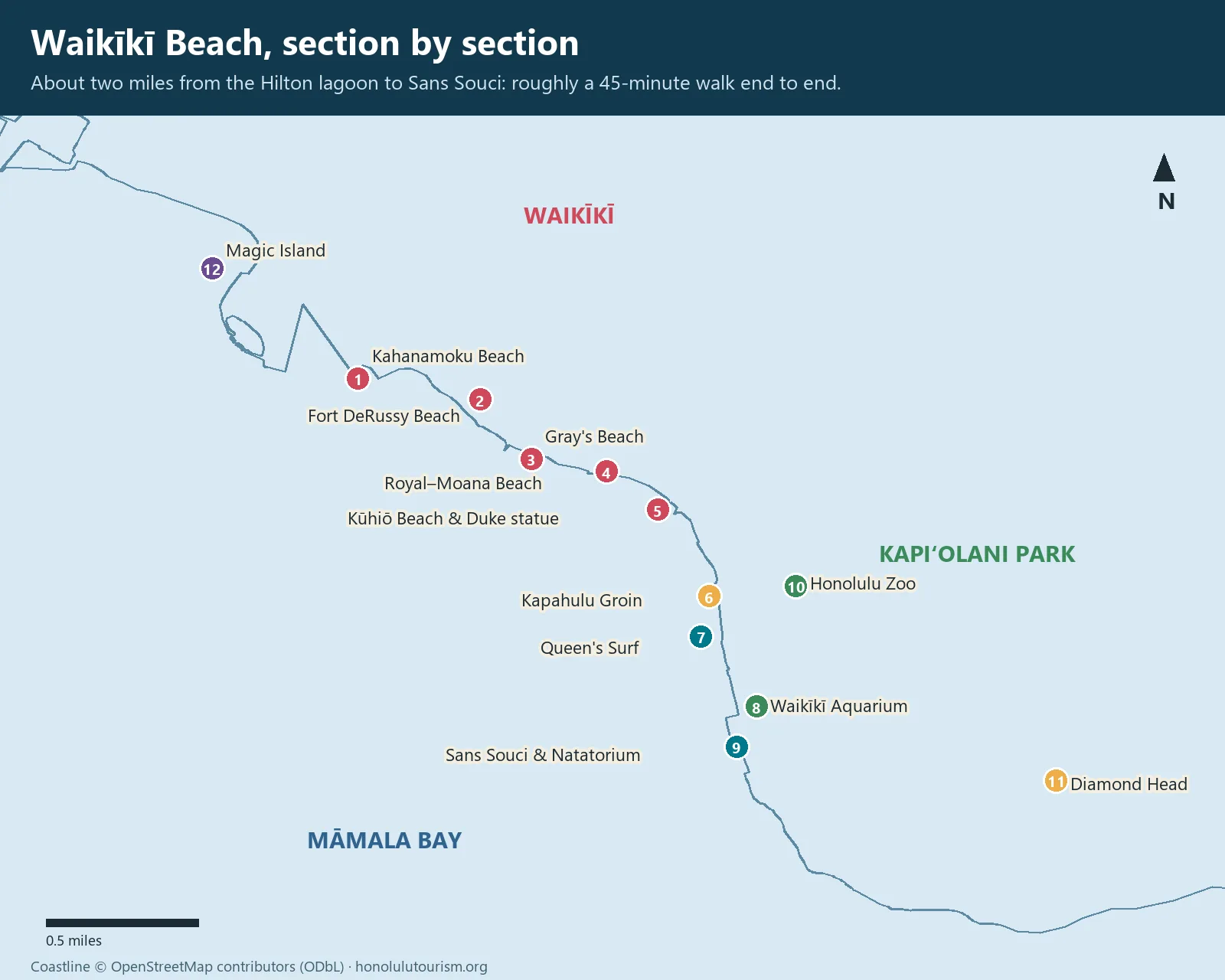
The Sections, ʻEwa to Diamond Head
1. Kahanamoku Beach and the Hilton Lagoon
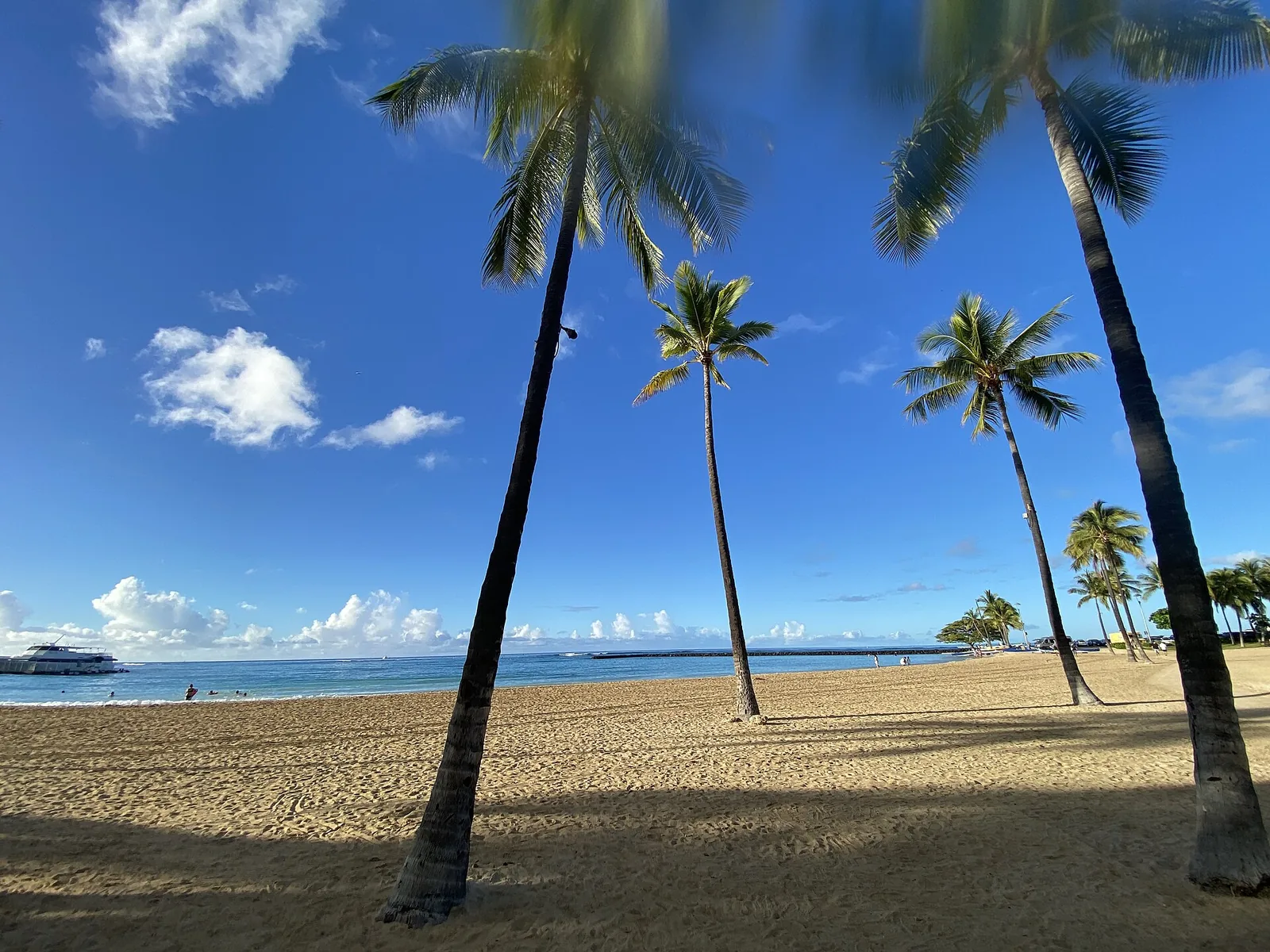
The ʻEwa end of Waikīkī fronts the Hilton Hawaiian Village, and like the lagoon behind it, the beach carries the Kahanamoku name. The water is sheltered and shallow, and the sand slopes so gently that small children can wade a long way out before it gets deep. If someone in your group is nervous in the sea, start here.
Two catches. Shade is scarce, so bring an umbrella or plan on a couple of hours rather than a whole day. And the city’s tower list has no lifeguard on this beach, so the gentle water is yours to supervise. Behind the sand, the Duke Kahanamoku Lagoon is calm, enclosed water that looks made for swimming; read the signs at the water’s edge before you get in.
Friday is the night to be here. The Hilton’s fireworks go up at 19:45 and this beach is the front row. Claim your patch of sand by 19:00, and expect a slow shuffle along Kālia Road when it’s over. The city closes Duke Kahanamoku Beach Park between 02:00 and 05:00.
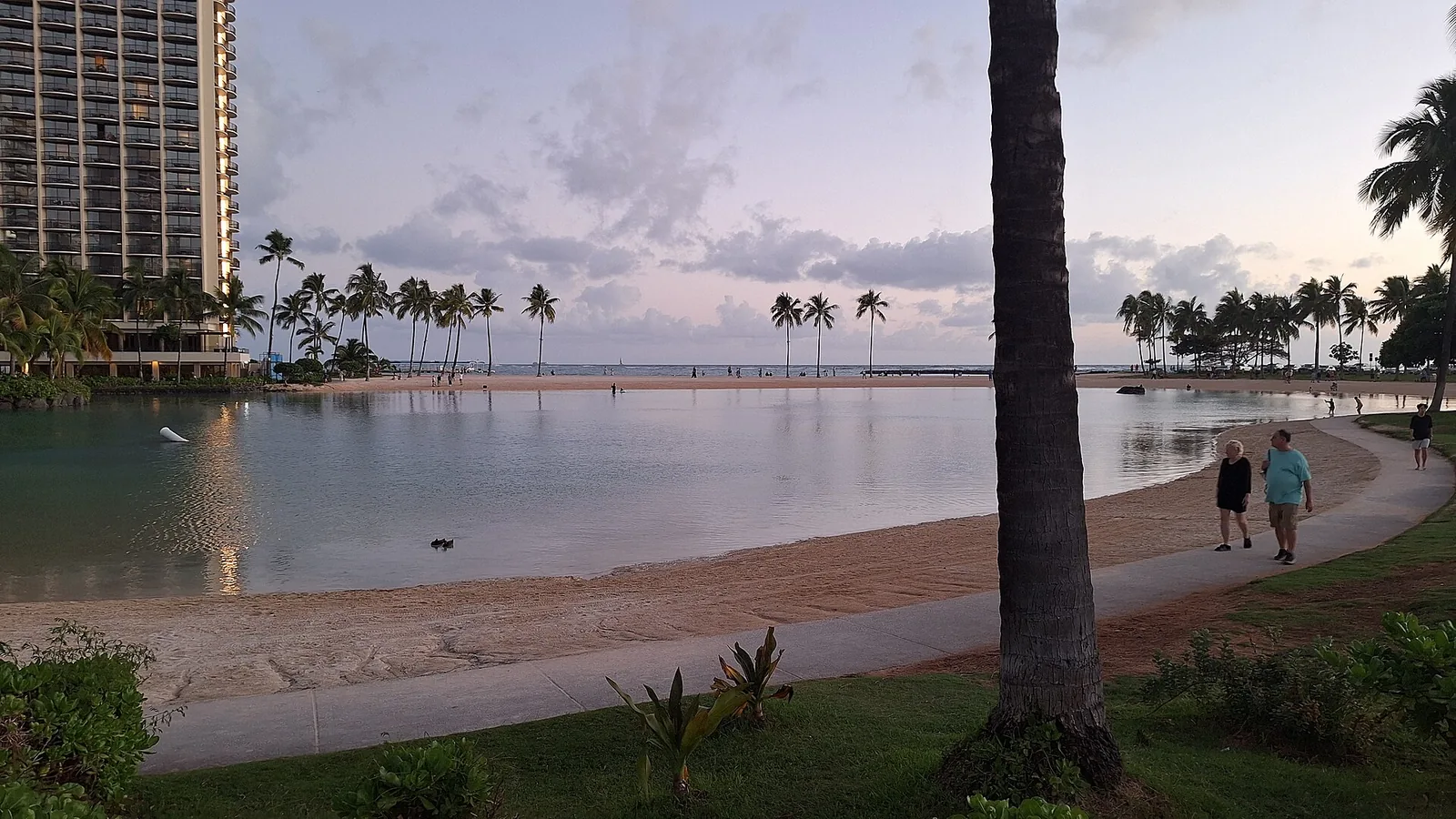
Cost: free · Hours: beach park closed 02:00–05:00; fireworks Fridays 19:45 · Bus: Route 42 serves Kālia Road · Allow: 2–3 hours, or an hour for the fireworks
2. Fort DeRussy Beach
Walk Diamond Head-ward from the Hilton and the sand widens into Fort DeRussy Beach, in front of the lawns of the Army’s Fort DeRussy, the Hale Koa Hotel and the U.S. Army Museum of Hawaiʻi. This is where families can still spread out at 11:00 without stepping over anyone, and by early afternoon the trees along the back of the beach throw proper shade.
The water is calm but shallow over reef and rubble in places, so swim at mid to high tide and wear reef shoes if your feet are soft. As at Kahanamoku Beach, the city’s list has no lifeguard tower here. Sunset is the other reason to come: from November to February the sun goes down well south of west, straight into open sea.
If you’re driving, the Army museum, which is free and open from Tuesday to Saturday, 10:00 to 17:00, validates parking at $4 for the first hour and $3 for each hour after.
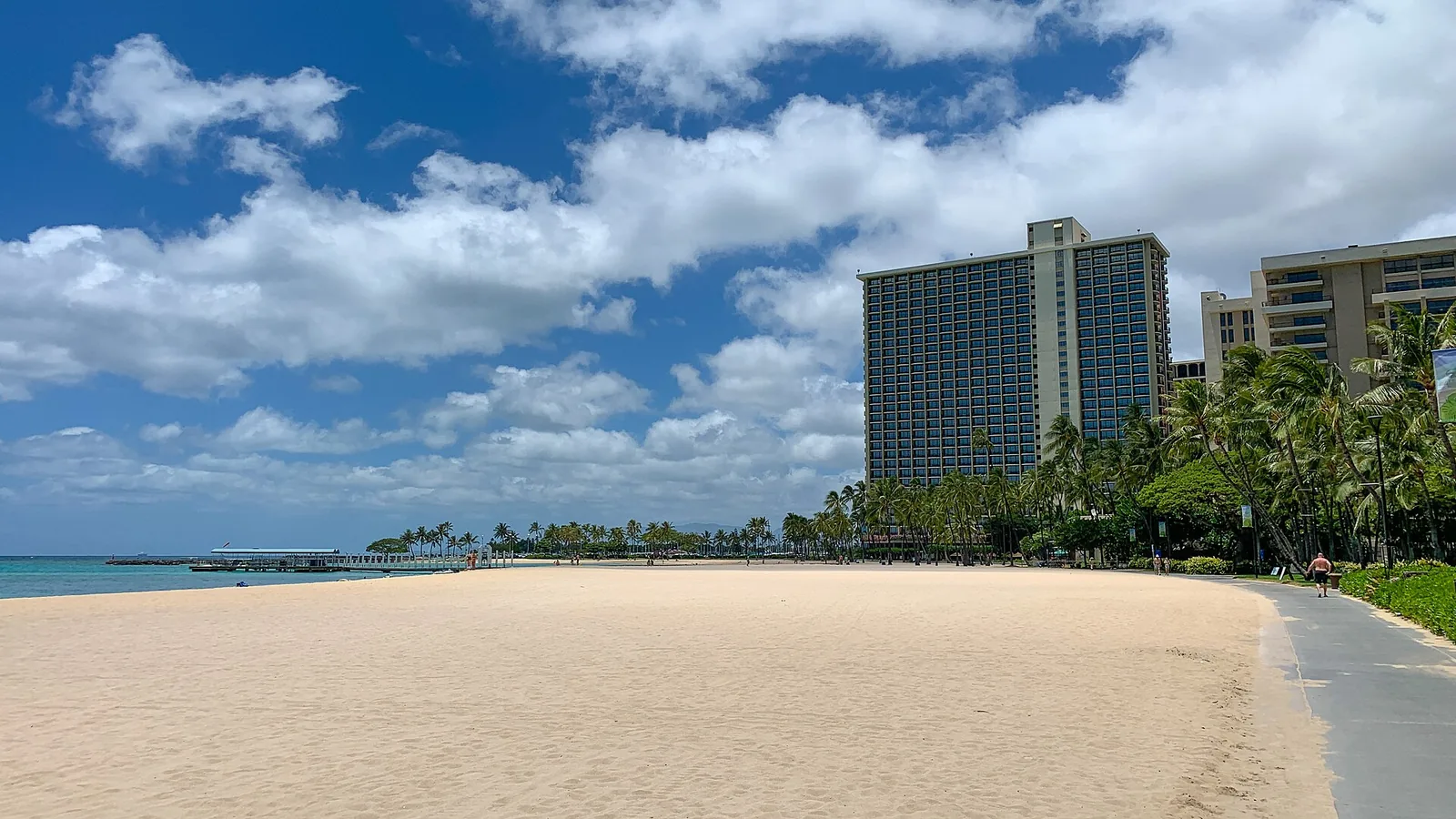
Cost: free; Army museum free · Hours: museum Tuesday–Saturday 10:00–17:00 · Bus: Route 42 on Kālia Road · Allow: half a day
3. Gray’s Beach (Kawehewehe)
Between the Halekulani and the Sheraton Waikiki, Waikīkī’s erosion problem is at its plainest. In places seawalls and wave-washed concrete stand where the sand used to be, and at high tide the water can reach them. There’s nowhere reliable to lay a towel, so treat this as a stretch to pass through rather than stop, and at high tide cut inland to Kālia Road instead of wading with your bags.
The old Hawaiian name for this shore is Kawehewehe, and it’s the name in the state’s plans. An April 2026 staff report to the Hawaiʻi Community Development Authority asks it to plan, design and build a sand-stabilising structure in the Kawehewehe sector; the report gave no construction date.
Come at sunset instead. The Halekulani’s open-air House Without A Key serves from 17:00 to 21:30 every night except Sunday, when it closes at 21:00, with Hawaiian music from 17:30 to 20:30 and hula from 18:30 to 20:30. There are no reservations for sunset cocktails, and it’s one of the most graceful evenings in Waikīkī, though you’ll be expected to order if you take a table. Our guide to Oʻahu after dark has more.
Cost: free to walk through; menu prices at House Without A Key · Hours: House Without A Key 17:00–21:30 nightly, to 21:00 on Sundays · Book: no reservations for sunset drinks · Allow: an hour at sunset
4. Royal–Moana Beach
This is the postcard: the pink Royal Hawaiian, built in 1927, and the white front of the Moana Surfrider, which opened on 11 March 1901 as Waikīkī’s first major hotel. The banyan in the Moana’s courtyard was planted in 1904 and stands about 75 feet high and 150 feet across. Offshore is Canoes, the long, rolling break where most visitors stand up on a board for the first time.
Beach stands along this stretch rent boards, sell lessons and launch outrigger canoes straight off the sand. Waikiki Beach Services, at the Sheraton Waikiki, charges from $95 a person in a group of four for a 1-hour-15-minute surf lesson ($150 one-to-one), and $48 a rider for a 30-minute outrigger canoe ride. Our guide to water activities on Oʻahu compares the options.
The swimming is easy, mostly over sand with patches of reef, and tower 2A stands in front of the Moana. The trade-off is space. By 10:30 on a sunny day you’ll be laying your towel within arm’s reach of strangers, so come early, or come for the water rather than the sand and retreat to a beachfront bar afterwards. The Moana Surfrider’s Beach Bar, steps from the sand, is open daily from 11:00 to 22:30, and Duke’s Waikīkī has its Barefoot Bar next door.
Cost: free; surf lessons from $95, canoe rides from $48 · Book: lessons a day or two ahead · Bus: Routes 2, 8 and 13 serve central Waikīkī · Allow: 2 hours at peak times
5. Kūhiō Beach and the Walled Pools
Kūhiō Beach is Waikīkī’s town square. Gordon Fisher’s bronze statue of Duke Kahanamoku has stood here since 1990 and is rarely without a fresh lei. Around it are the Kapaemahu stones behind their railing, the grassy mound where the Saturday hula show happens, and the Waikīkī police station. Our Hawaiian culture guide has the background.
Two long concrete walls run parallel to the shore and enclose a pair of calm, warm pools, which is why they fill with children. They are not as gentle as they look. The bottom is uneven, with sudden holes, and when the surf is up, water drains out through the gaps at the ends of the walls. Keep small children within arm’s reach, stay away from the openings, and don’t walk along the tops of the walls, which are slick with algae.
The Kūhiō Beach Hula Show runs on Saturdays from 18:30 to 19:30, weather permitting, on the Hula Mound on the ocean side of Kalākaua Avenue near the statue. It’s free, and one of the best free things to do on Oʻahu; check the show’s own site for cancellations before you go. Lifeguards are close at hand: towers 2B, by the police station, 2C, 2DP and 2D all stand along this stretch. The city closes Kūhiō Beach Park from midnight to 05:00.
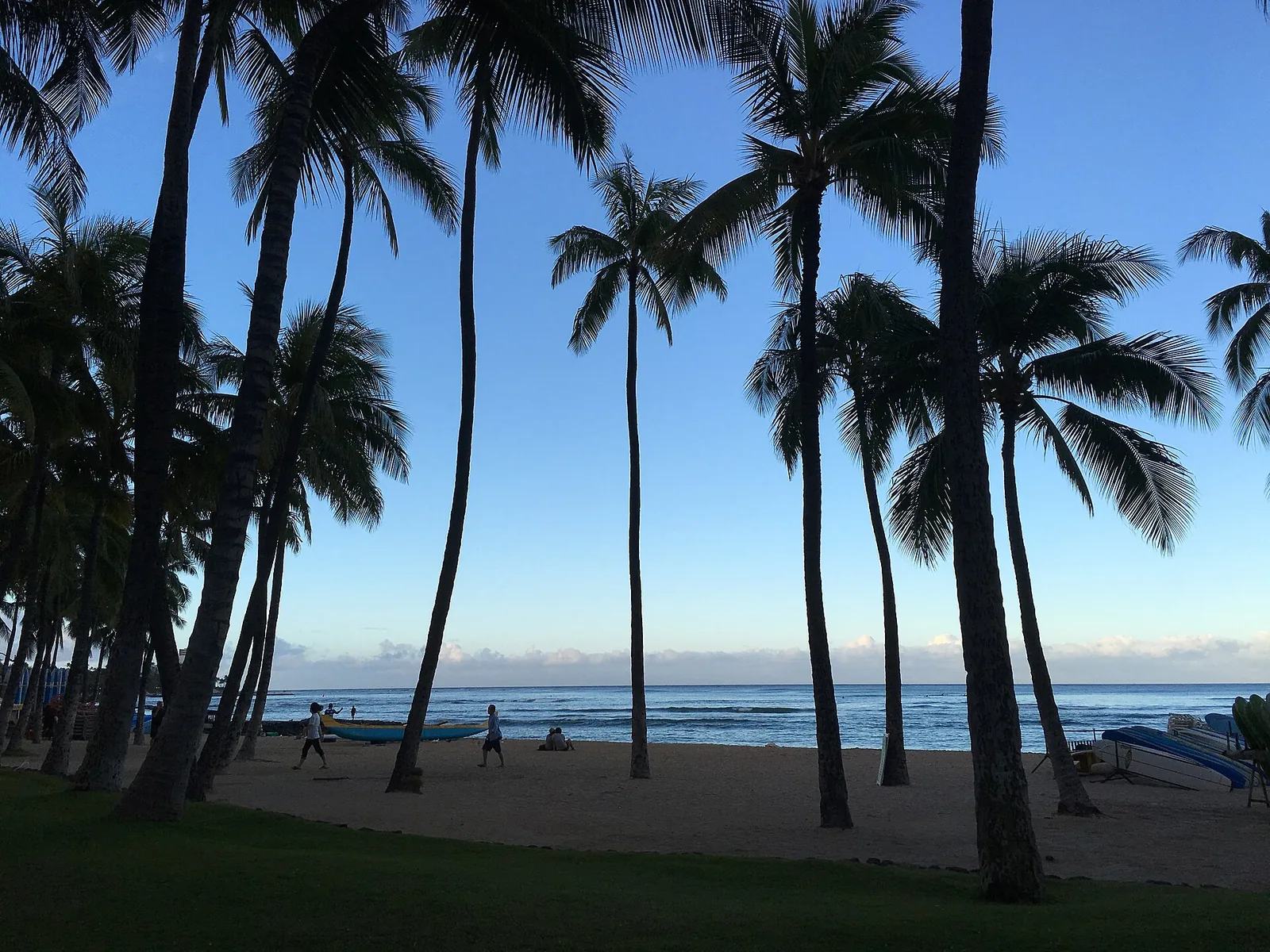
Cost: free · Hours: park closed 00:00–05:00; hula show Saturdays 18:30–19:30 · Bus: Routes 2 and 13 · Allow: an hour to look around, a morning to swim
6. The Kapahulu Groin
At the foot of Kapahulu Avenue a concrete groin runs straight out to sea with a flat walkway along its top. Stand on it at sunset and watch the surfers on the breaks off Kūhiō and Queen’s. Right beside it, a short, heavy shorebreak dumps onto shallow sand. That wave belongs to experienced bodyboarders, and it’s the wrong place for anyone learning.
The groin also marks the start of the Waikīkī Marine Life Conservation District, which runs Diamond Head-ward to the ʻEwa wall of the Natatorium and out at least 500 yards from the high-water mark, or to the edge of the reef. Inside it, fishing for, taking or harming any marine life is banned, and so is taking sand, coral or rock. That protection is why the reef off the next two beaches repays a snorkel.
Leonard’s Bakery, at 933 Kapahulu, is open daily from 05:30 to 19:00 for hot malasadas, and our guide to Honolulu food and restaurants covers the avenue’s other plate-lunch and poke stops. Route 13 runs up Kapahulu, and the W Line from the airport runs to Kapahulu Avenue.
Cost: free · Bus: Route 13 and the W Line on Kapahulu Avenue · Allow: 30 minutes at sunset
7. Queen’s Surf
Past the groin the hotels stop and Kapiʻolani Park takes over. Queen’s Surf is sand backed by lawn and big shade trees, long known as a welcoming beach for Honolulu’s LGBTQ+ community, and at weekends it fills with local families who arrive with coolers, pop-up shades and music for the whole day.
On a calm morning the reef just offshore is Waikīkī’s easiest snorkel from the sand: reef fish, the odd green sea turtle, and the protection of the conservation district. Give turtles at least 10 feet. Tower 2E, at 2601 Kalākaua Avenue, is the nearest city lifeguard tower. The Honolulu Zoo is across the road, open from 10:00 to 16:00 daily with last entry at 15:00, and its Kapahulu Avenue car park charges $1.50 an hour.
Cost: free; zoo car park $1.50 an hour · Hours: Kapiʻolani Park closed 00:00–05:00 · Bus: Routes 2 and 13 · Allow: half a day
8. Kapiʻolani Beach Park
The grassy stretch between Queen’s Surf and the aquarium is picnic territory. Kapiʻolani Park, dedicated on 11 June 1877, backs the sand with lawns and old trees, and far fewer visitors walk this far than crowd the hotel beaches.
The swimming is over shallow reef, best at mid to high tide, and tower 2F, at 2709 Kalākaua Avenue, is the nearest lifeguard. Drivers can try the metered spaces on the park side of Kalākaua or the Waikīkī Shell lot on Monsarrat Avenue, which the zoo lists as free. Route 2 carries on from here round to Diamond Head, if you’re hiking Diamond Head the next morning.
Cost: free; street parking metered · Hours: park closed 00:00–05:00 · Bus: Route 2 · Allow: an afternoon
9. The Waikīkī War Memorial Natatorium
Beside the Waikīkī Aquarium stands a grand arch with nothing behind it but a closed saltwater pool. The War Memorial Natatorium was completed in 1927, and Duke Kahanamoku took the first swim at its opening on 24 August that year. It closed to the public in 1979 for safety reasons and has stayed shut. In August 2025 Mayor Rick Blangiardi called restoring the pool “a long shot”, with cost estimates of $50 million to $100 million.
You can admire the arch from Kalākaua Avenue, but don’t climb the walls or try to swim in the pool. The Ocean Safety Department’s District 1 lifeguard sub-station is here, and the marine conservation district ends at the Natatorium’s ʻEwa wall.
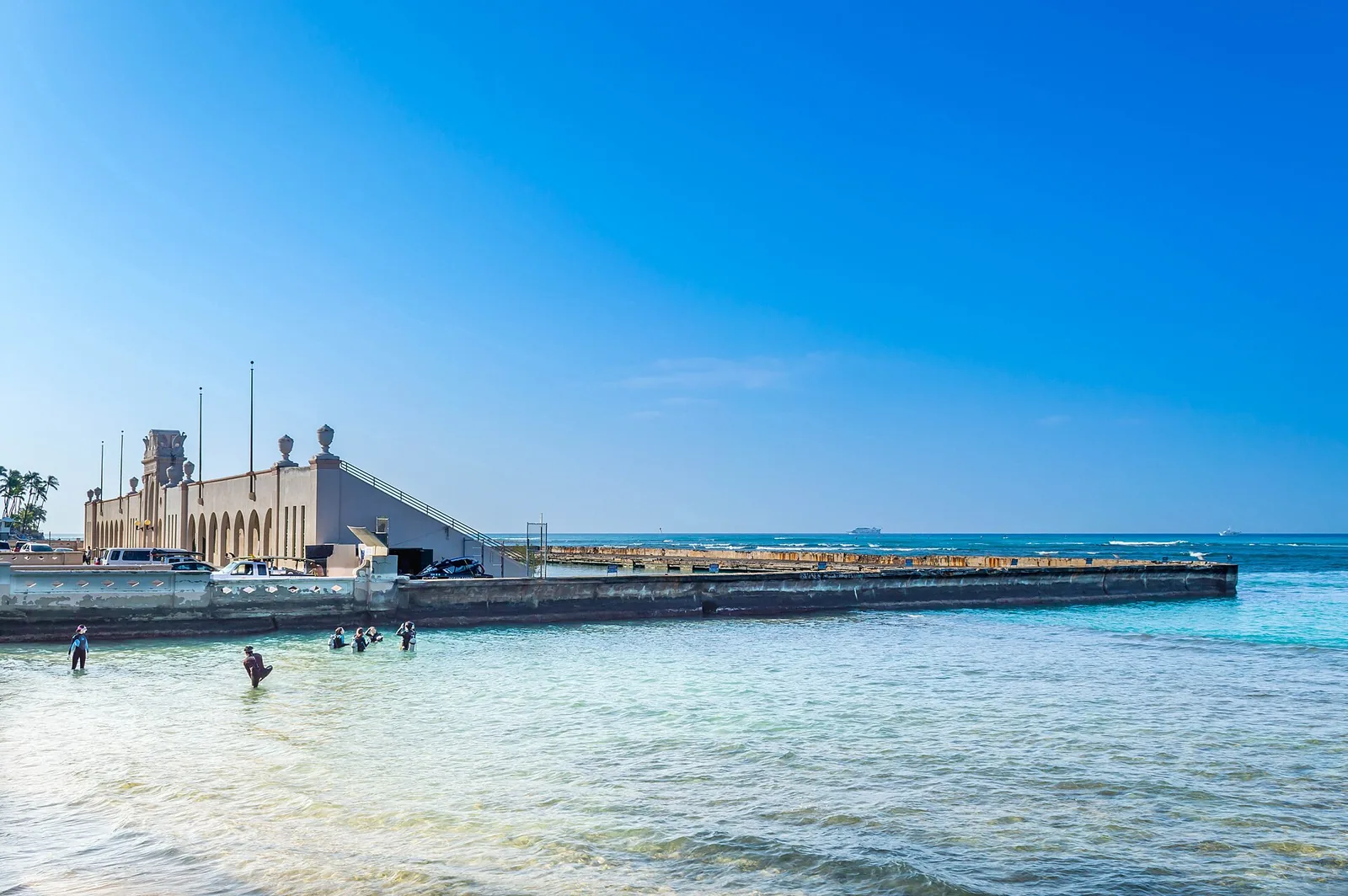
Cost: free to look · Bus: Route 2 · Allow: 15 minutes
10. Kaimana Beach (Sans Souci)
The Diamond Head end is where plenty of Honolulu residents actually swim. Kaimana Beach is still widely called Sans Souci, after a guest house that George Lycurgus took over and renamed in 1893; Robert Louis Stevenson stayed there later that year. Today the Kaimana Beach Hotel sits on the sand, and the water off it, a sheltered shelf of sand and reef, is usually at its calmest in the early morning, before the trade winds pick up.
Tower 2H, at 2815 Kalākaua Avenue, watches over the beach. This is also monk seal country. A Hawaiian monk seal gave birth on Kaimana Beach on 3 May 2026, and the state put up temporary fencing around mother and pup. Stay at least 50 feet from any monk seal and 150 feet from a mother with a pup, and treat any fencing you find as the line.
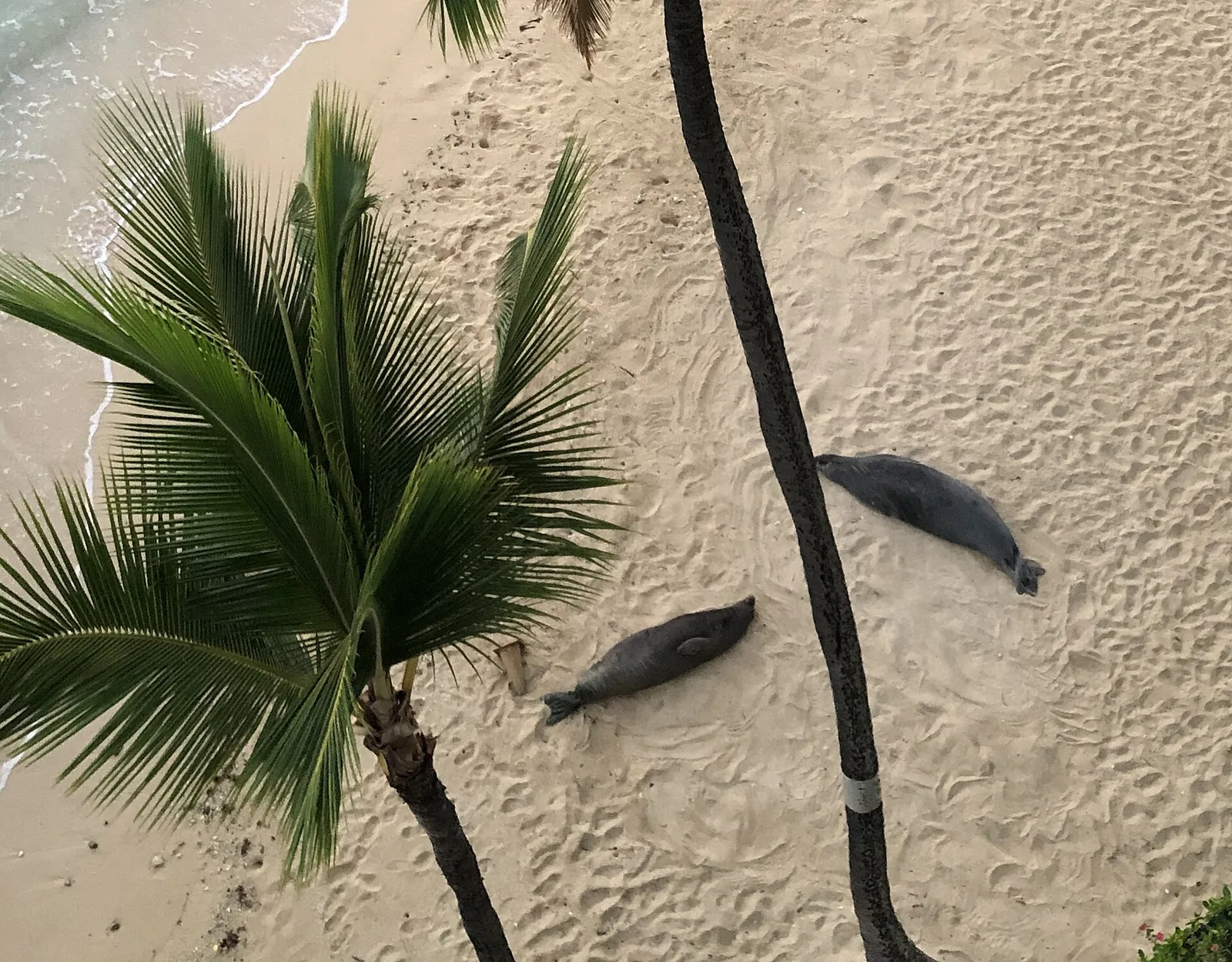
Cost: free · Hours: Kapiʻolani Park closed 00:00–05:00 · Bus: Route 2 · Allow: an hour for a morning swim
Choosing Between the Waikiki Beach Sections
The short version, by what you want from the day:
- Toddlers and nervous swimmers: Kahanamoku Beach for its gentle slope, or the Kūhiō pools with a hand always within reach. Kūhiō has lifeguards; Kahanamoku has no city tower. Our Hawaiʻi with kids guide has more on beaches for families.
- A first surf lesson: Royal–Moana, where the schools launch straight onto Canoes.
- Snorkelling from the sand: Queen’s Surf on a calm morning. For turtles in deeper water, Holokai’s Turtle Canyon snorkel cruise starts at $80 and boards on Waikīkī Beach.
- Room and shade: Fort DeRussy or Kapiʻolani Beach Park.
- Swimming with the regulars: Kaimana Beach, early.
- Sunset: Fort DeRussy or Kahanamoku Beach in the cooler months, the Kapahulu groin all year, or a drink at House Without A Key. Our guide to the best sunset spots on Oʻahu has the island-wide picks.
- Friday fireworks: Kahanamoku Beach, settled by 19:00 for the 19:45 show.
- People-watching: Royal–Moana and Kūhiō, any time after 10:00.
- Skip it for sunbathing: Gray’s Beach, where there’s often no sand to lie on.
The best day uses three of them: an early swim at Kaimana or Queen’s, a lesson or canoe ride off Royal–Moana mid-morning, the hot middle of the day in the shade at Fort DeRussy, and sunset from the Kapahulu groin or House Without A Key. Our list of things to do in Waikīkī fills the gaps, and our Oʻahu itinerary shows where a Waikīkī day fits in a week.
Staying Safe on Every Section
According to the state Department of Health, drowning is the leading cause of injury-related death among visitors to Hawaiʻi, and Waikīkī’s gentle reputation makes people careless. Swim in front of a staffed tower, between 08:00 and 18:30, and remember that the city lists none for the three ʻEwa sections; if you can’t see a lifeguard, assume there isn’t one.
- The Kūhiō walls: an uneven bottom, outflow at the openings and slippery tops.
- The Kapahulu groin: a heavy shorebreak beside it. Watch it; don’t learn on it.
- Summer south swells: Canoes and Queens get bigger and fill with experienced surfers. Beginners should stay inside and ask the lifeguard before going out.
- Box jellyfish: they drift onto south-facing shores around 8 to 10 days after a full moon. The Waikīkī Aquarium’s calendar marks 2 to 4 December 2026 as high-probability days; check it for the months after.
- Rain: stay out of the water for 72 hours after heavy rain, when runoff carries bacteria into the sea, and check the Department of Health’s beach advisories after storms.
- Dawn, dusk and night: the state’s shark-safety advice is to stay out of the water at those times.
- Wildlife: keep 10 feet from turtles, 50 feet from monk seals and 150 feet from a mother and pup.
Getting There, Parking and Beach Rules
You don’t need a car for any of this. TheBus Routes 2, 8 and 13 serve central Waikīkī, Route 42 runs along Kālia Road at the Fort DeRussy and Hilton end, and Route 2 carries on past Kapiʻolani Park towards Diamond Head. From the airport, the W Line runs from the Lelepaua Skyline station to Kapahulu Avenue. A ride costs $3.25 in cash, and a HOLO card caps fares at $7.50 a day. New timetables take effect on 6 December 2026 on Routes 2, 8 and 42 and the W Line, so check thebus.org before you rely on a schedule. Our guide to getting around Oʻahu covers the rest.
If you do drive, park at the Diamond Head end. The Honolulu Zoo’s car park on Kapahulu Avenue charges $1.50 an hour, the Waikīkī Shell lot on Monsarrat Avenue is listed as free, and there are metered spaces along the park side of Kalākaua. In the hotel stretch, garages charge hotel rates; the exception worth knowing is the Army museum’s validation at Fort DeRussy. If you’re still choosing a hotel, our guide to where to stay on Oʻahu can help.
A few rules hold on every section. The sand is public in Hawaiʻi, including in front of the hotels; the chairs, cabanas and umbrellas the hotels set out are not. Alcohol isn’t allowed at Honolulu’s city beach parks, and smoking is banned on city beaches; check honolulu.gov/dpr for the current park rules. Between the Kapahulu groin and the Natatorium nothing may be taken from the reef, and wherever a monk seal is resting, the state’s fencing is the line. Our complete guide to Waikīkī covers the rest of the neighbourhood.
To see the whole beach from the water, our Waikīkī sunset cruise guide compares the catamarans that board on the sand.
Frequently Asked Questions
How many Waikiki beach sections are there?
It depends who’s counting. Guidebooks divide the shore into different numbers of beaches, from a handful to ten. This guide uses ten, adding the Kapahulu groin, Kapiʻolani Beach Park, the Natatorium and Kaimana Beach, because each behaves so differently in the water.
Which part of Waikīkī Beach is best for families?
For toddlers, Kahanamoku Beach at the Hilton end has the gentlest slope and the calmest water, though no city lifeguard tower. The walled pools at Kūhiō Beach are calm too, with four lifeguard towers along that stretch, but the bottom is uneven, so keep small children within arm’s reach. Fort DeRussy and Kapiʻolani Beach Park have the most room and shade for a long day.
Where are the lifeguards on Waikīkī Beach?
The city lists eight towers from the Moana Surfrider to Kaimana Beach: 2A by the Moana, 2B by the police station, 2C, 2DP and 2D along Kūhiō Beach, 2E and 2F by Kapiʻolani Park, and 2H at Kaimana. They’re staffed from 08:00 to 18:30 daily. The list has no tower at Kahanamoku Beach, Fort DeRussy or Gray’s Beach.
Where is the best snorkelling on Waikīkī Beach?
Queen’s Surf, on a calm morning at mid to high tide. The reef there lies inside the Waikīkī Marine Life Conservation District, where taking any marine life is banned; expect reef fish and sometimes a green sea turtle, and keep 10 feet from turtles. For deeper water and more turtles, a Turtle Canyon snorkel cruise from Waikīkī Beach starts at $80 with Holokai.
Can you walk the whole of Waikīkī Beach?
Yes, in under an hour from the Hilton lagoon to Kaimana Beach, on the sand and the beachfront paths. At high tide the stretch around Gray’s Beach can leave you wading, so cut inland to Kālia Road there. Go early or late: the sand gets hot by midday.
Where do locals swim in Waikīkī?
Mostly at the Diamond Head end. Kaimana Beach has its early-morning regulars, and Queen’s Surf and Kapiʻolani Beach Park fill with local families at weekends. Give the regulars room at the Kapahulu groin’s shorebreak, which isn’t a place to learn.
Photo Credits
- Kahanamoku Beach (featured): Fuzheado, CC BY-SA 3.0
- Map: honolulutourism.org; coastline data © OpenStreetMap contributors, ODbL
- Duke Kahanamoku Lagoon: Aaron Lucas, CC BY-SA 4.0
- Fort DeRussy Beach: Daniel Ramirez, CC BY 2.0
- Kūhiō Beach: Thomas Woodtli from Zürich, Switzerland, CC BY-SA 2.0
- War Memorial Natatorium: Gerald Watanabe, CC BY-SA 4.0
- Monk seals at Kaimana Beach: Eqpk, CC BY-SA 4.0