For half the year, the North Shore Oahu coast is a string of calm, glassy bays where children paddle and snorkellers drift over lava-rock pools. For the other half, it’s the most famous surf arena on Earth, and the same beach that was a swimming pool in August can drown a strong swimmer in January. That single fact decides everything about a visit: where you stop, whether you get in the water, where you’ll park and how long the drive takes. Below is the whole coast in driving order, from Haleʻiwa to the Kahuku shrimp trucks, with a month-by-month surf table, a timed day trip from Waikīkī for summer and for winter, realistic parking windows for the beaches that fill first, and the prices, hours and bus routes for every stop.
Update, 10 September 2026: After Hurricane Lowell, the Mokulēʻia permit gate area and the Keawaʻula section of Kaʻena Point State Park remain closed, and the Department of Health has a brown-water advisory on the waters around Oʻahu. The main North Shore beaches and Haleʻiwa are open; stay out of the sea until the advisory lifts, and for 72 hours after any heavy rain. Check Hawaiʻi State Parks before heading west of Haleʻiwa.
North Shore Oahu at a glance
The North Shore runs for roughly 15 miles along Kamehameha Highway, from the old plantation town of Haleʻiwa in the west to Kahuku and Turtle Bay in the north-east. It’s about an hour from Waikīkī by car through the middle of the island, and it’s a different world from Honolulu: two-lane road, surf shops, fruit stands, food trucks, low houses behind the dunes and very little that’s taller than a palm tree. There are no big hotels except Turtle Bay, and no traffic lights for long stretches.
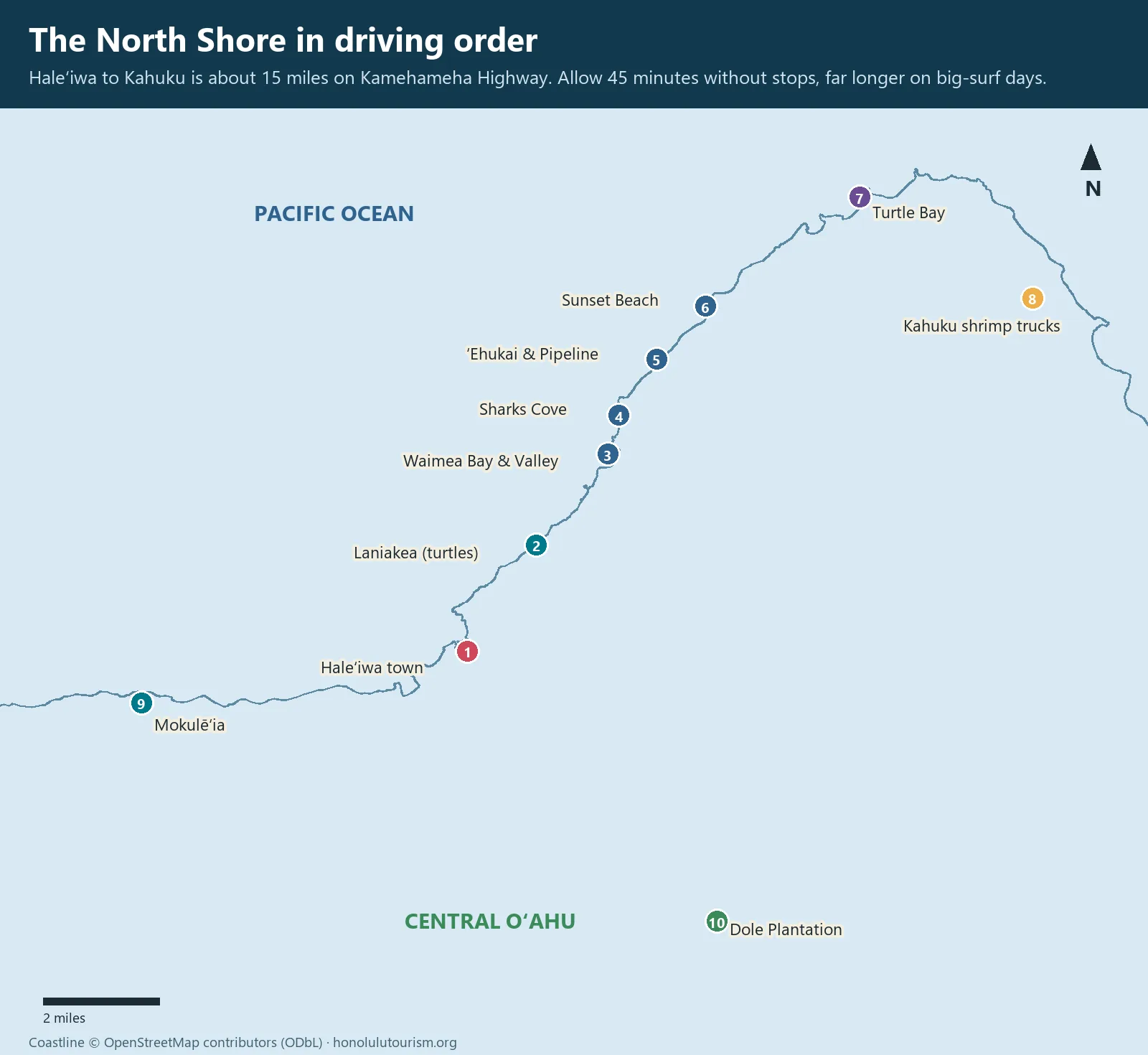
Three things catch visitors out. The first is the season: from roughly November to March, big swells from North Pacific storms close beaches to swimming and fill the road with surf-watchers. The second is parking: most beach car parks are tiny, and on good days they’re full by mid-morning. The third is the drive home: traffic backs up along the highway into Haleʻiwa in the afternoon, and a day that ends at 5pm on the wrong side of town can end at 7pm in Waikīkī. Plan around all three and the North Shore is the best day out on Oʻahu.
| Stop | What it’s for | Summer | Winter | Cost |
|---|---|---|---|---|
| Haleʻiwa town | Shops, food, shave ice | Busy | Busy | Free |
| Laniakea | Turtles on the sand | Best odds | Rough surf | Free |
| Waimea Bay | Swimming or big-wave watching | Swim | Watch only | Free |
| Waimea Valley | Garden walk to a waterfall | Open Tue–Sun | Open Tue–Sun | $26 |
| Sharks Cove | Snorkelling | Excellent | Dangerous | Free |
| Pipeline | Surf-watching | Flat | World-class waves | Free |
| Sunset Beach | Long sandy beach | Swim | Watch only | Free |
| Turtle Bay | Sheltered cove, trails | Calm | Check conditions | Free access |
| Kahuku | Shrimp trucks | Open | Open | From $14 |
North Shore surf, month by month
The North Shore’s surf follows the North Pacific storm season. These are typical conditions; any given week can surprise you, so always check with a lifeguard before going in.
| Month | Surf | Swimming | Notes |
|---|---|---|---|
| January | Big to giant | Dangerous most days | Peak big-wave season; watch from the sand |
| February | Big | Dangerous most days | Frequent large swells |
| March | Big, easing late | Mostly dangerous | Spring break crowds |
| April | Easing | Some calm days | Check daily |
| May | Small | Often good | Snorkelling season begins |
| June | Flat to small | Good | Glassy mornings |
| July | Flat to small | Good | Busiest summer month |
| August | Flat to small | Good | Warm water, quieter late in the month |
| September | Mostly flat | Good | The quietest, warmest month |
| October | First swells | Check daily | Conditions start to change |
| November | Big swells return | Often dangerous | Surf-watching season begins |
| December | Big to giant | Dangerous most days | Pipe Masters waiting period 8–20 December 2026 |
If you’re here in summer, this is your chance to swim and snorkel at beaches that are off limits for half the year. If you’re here in winter, you’ll see waves few places on Earth can match, but you should treat every North Shore beach as a place to watch, not to swim. For how the North Shore fits with the rest of the island’s seasons, see our guide to the best time to visit Hawaii.
A North Shore Oahu day trip, hour by hour
This is the day we’d plan from Waikīkī, in two versions. Both start early, drive up through the middle of the island in the morning, and head home before the afternoon traffic builds. If you’d rather do a full circle-island loop, reverse the direction: go east from Waikīkī, up the windward coast in the morning, and reach the North Shore in the afternoon; it’s about 110 miles and three and a half hours of driving without stops.
The summer version (May to October)
- 7:30am: Leave Waikīkī via the H-1 and H-2, about an hour to Haleʻiwa.
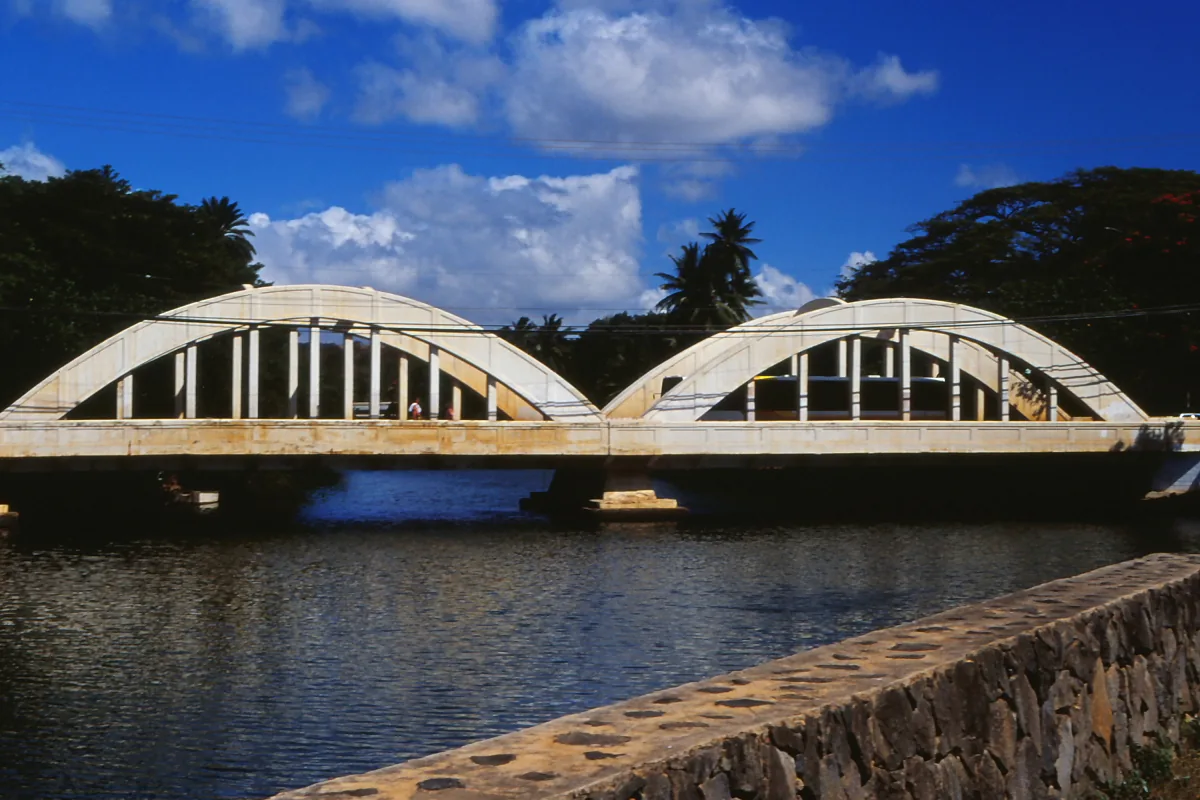
- 8:30am: Coffee in Haleʻiwa and a walk over the Anahulu bridge.
- 9am: Park at Waimea Bay before the lot fills, and swim in the calm, deep-blue bay. Lifeguards are on duty from 8am to 6:30pm.
- 11am: Snorkel at Sharks Cove, five minutes up the road, before the midday crowds.
- 12:30pm: Lunch at the shrimp trucks in Kahuku, 20 minutes further on.
- 2pm: Turtles at Laniakea on the way back, between 11am and 2pm being the best window, or a quiet swim at Kuilima Cove by Turtle Bay.
- 3:30pm: Shave ice at Matsumoto’s in Haleʻiwa, then home, or the Haleʻiwa Farmers Market if it’s a Thursday.
The winter version (November to March)
- 7am: Leave Waikīkī early. On big-swell days, the North Shore fills up fast.
- 8am: Pipeline and Sunset Beach, watching the surf from the sand while the light is behind you.
- 9:30am: Waimea Bay lookout for the big waves. Don’t go in, and stay well back from the shorebreak.
- 10:30am: Waimea Valley, $26, for the garden walk to the waterfall, open 9am to 4pm and closed on Mondays.
- 12:30pm: Lunch at the shrimp trucks.
- 2pm: Haleʻiwa town and shave ice.
- 3pm: Leave for Waikīkī, or stay for sunset and drive back after dark.
Cost: free beaches; Waimea Valley $26; shrimp plate from $14 · Book: no · Bus: Route 60 from Ala Moana · Allow: a full day
North Shore stops in driving order
These are the stops from the middle of the island to the North Shore and along the coast, in the order you’ll reach them driving from Waikīkī.
1. Dole Plantation
On the central plain above Wahiawā, the Dole Plantation is the traditional first stop on the way north. Entry is free; the pineapple train ride costs $15 and the garden maze $10, and it’s open from 9:30am to 5:30pm. It’s commercial and it’s a bit of a tourist trap, but children love the train and the pineapple soft-serve, and it breaks up the drive. If you’re travelling without children, skip it and get to the beaches earlier.
Cost: free entry; train $15, maze $10 · Hours: 9:30am–5:30pm · Book: no · Bus: Route 52 to Wahiawā · Allow: 45 minutes
2. Haleʻiwa town
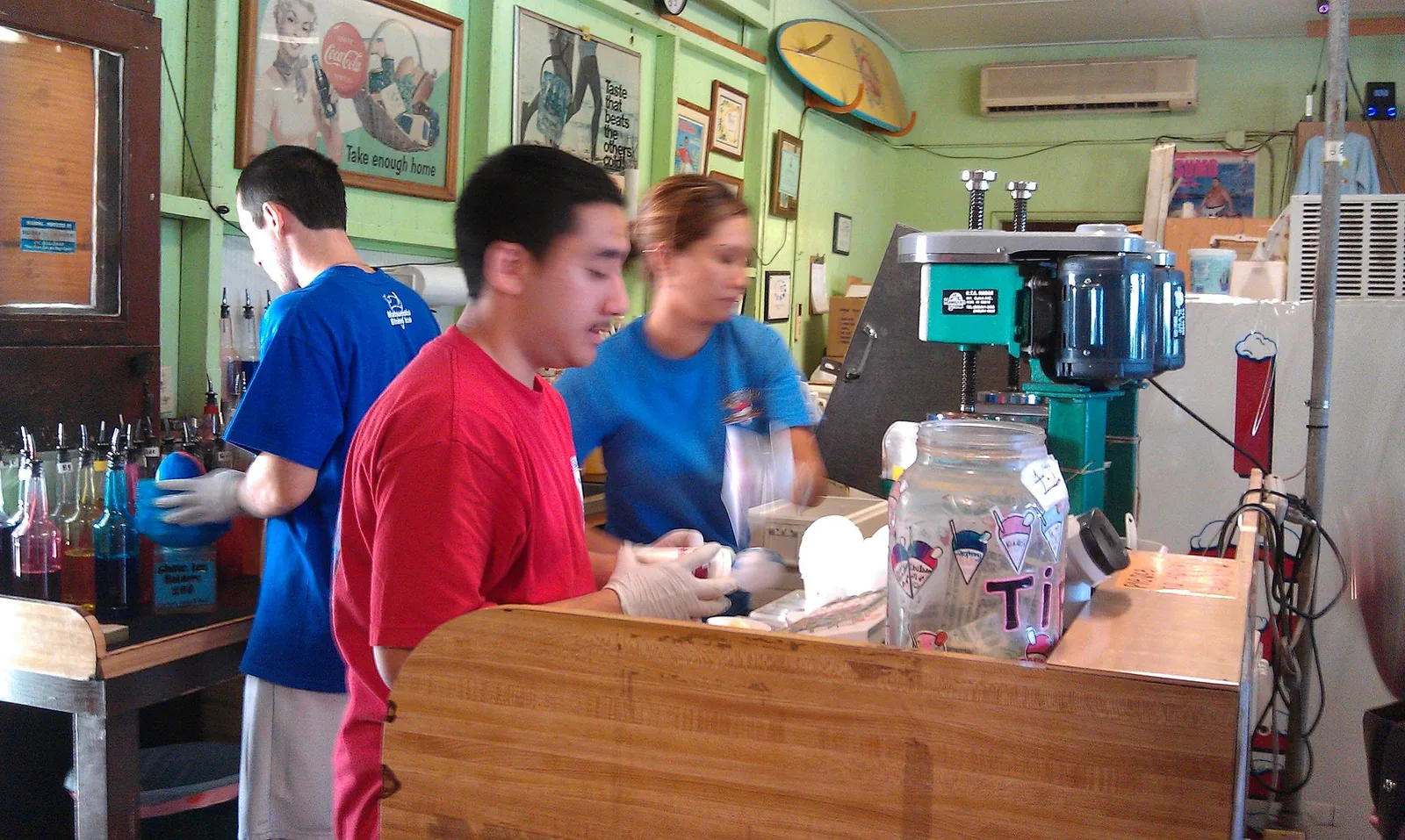
Haleʻiwa is the North Shore’s heart: a former plantation town of wooden shopfronts, surf shops, galleries and food trucks, reached across the double-arched Anahulu bridge. It’s busy, especially at lunchtime, but it has the best coffee, food and shopping on the coast. Matsumoto Shave Ice, open from 10am to 6pm, is the best-known shave ice on the island, and the queue moves quickly. Giovanni’s has a second shrimp truck in town, open daily from 10:30am to 5pm. On Thursday afternoons, from 3pm to 7pm, the Haleʻiwa Farmers Market sells fruit, local food and crafts.
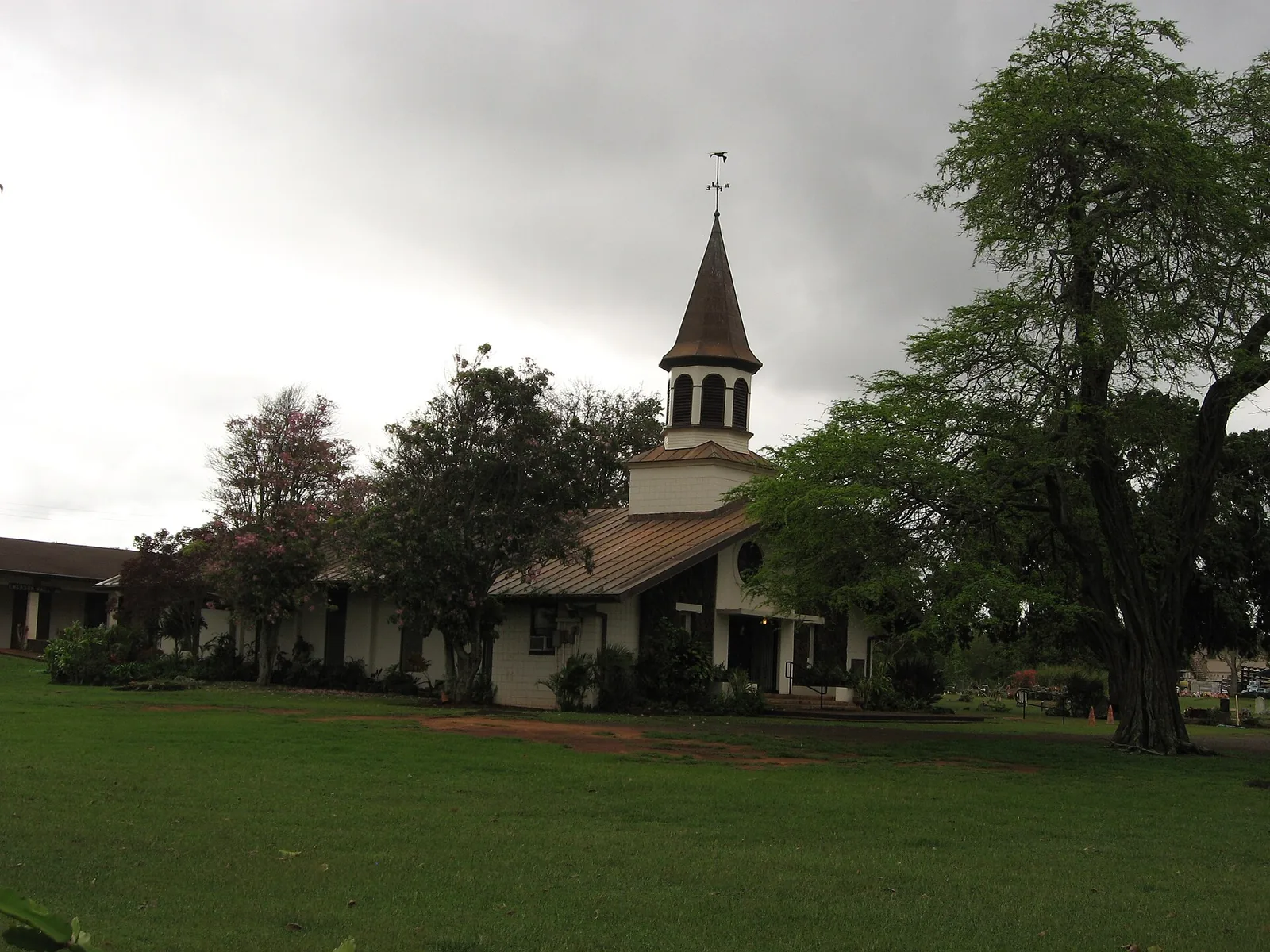
Look out for Liliʻuokalani Protestant Church on the main road, whose congregation dates back to 1832, one of the reminders that Haleʻiwa was a community long before it was a surf town. It’s a working church, so visit quietly.
Cost: free; shave ice and food extra · Hours: Matsumoto’s 10am–6pm; farmers market Thursday 3–7pm · Bus: Route 60 · Allow: 1–2 hours
3. Haleʻiwa Aliʻi and Haleʻiwa Beach Park
The town’s two beaches sit either side of the small boat harbour. Haleʻiwa Aliʻi Beach Park has a lifeguard and a well-known surf break, gentle in summer and serious in winter. Across the harbour, Haleʻiwa Beach Park is calmer in summer and a good place for a swim after lunch in town. In winter, both are for watching.
Haleʻiwa’s small boat harbour is also the base for snorkelling, dolphin-watching and fishing trips. Choose an operator that follows the federal rules: since 2021 it has been illegal to swim with Hawaiian spinner dolphins or to approach within 50 yards of them, by boat, board or in the water. A good crew will keep its distance and still show you plenty.
Cost: free · Lifeguard: yes, at Aliʻi · Parking: free park lots · Bus: Route 60 · Allow: 1 hour
4. Laniakea Beach (Turtle Beach)
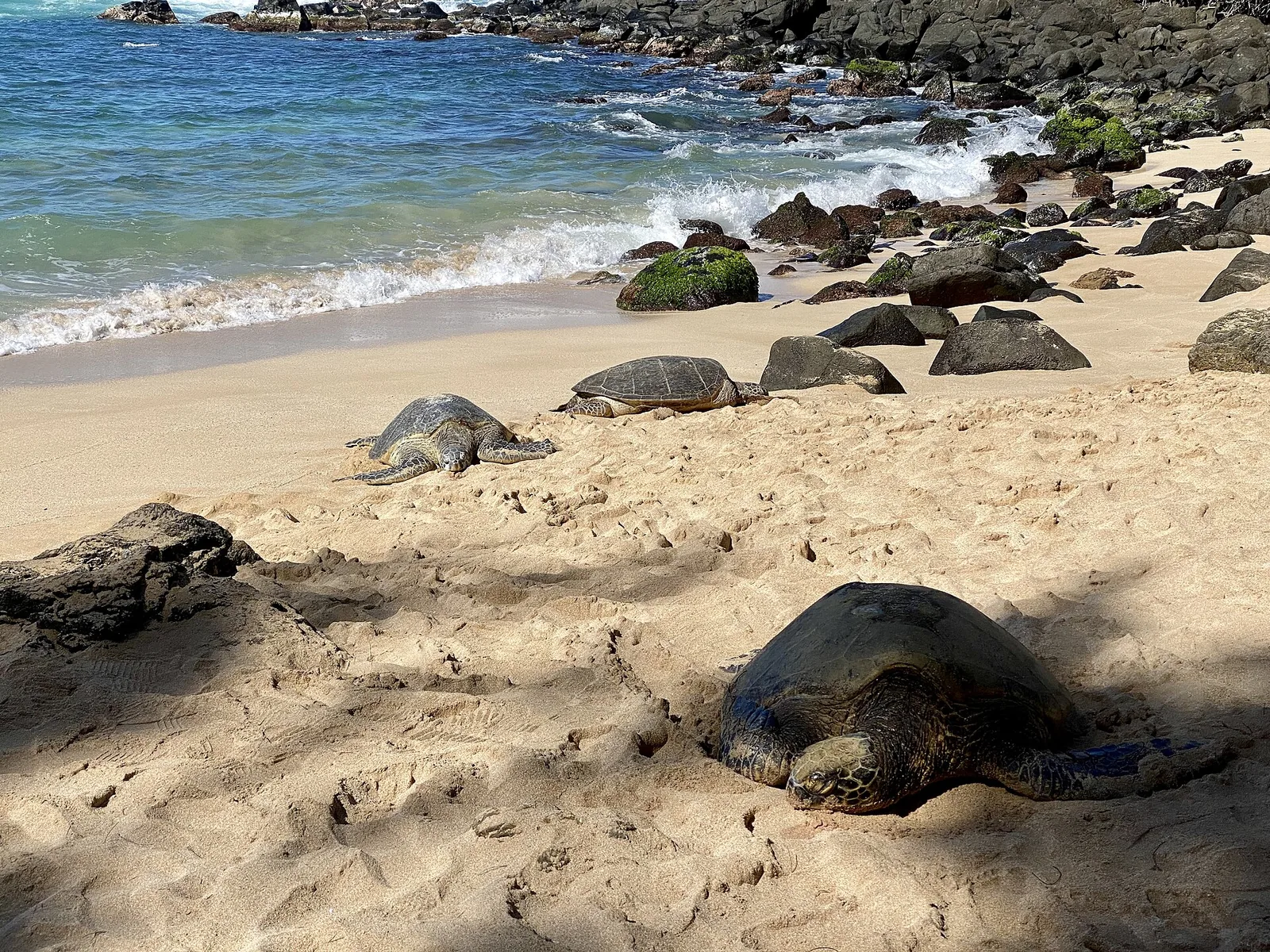
A few minutes past Haleʻiwa, green sea turtles often haul out on the sand at Laniakea to rest and warm up, most often between about 11am and 2pm, and most reliably in summer. Volunteers from Mālama na Honu have looked after the site since 2012, roping off a 10-foot zone around resting turtles and answering questions. Respect the rope, never touch or feed a turtle, and don’t block its path to the water.
Parking is the challenge. A road and bridge project here was still being finished in the summer of 2026, and access has been changing, so follow the current signs and traffic staff rather than an old map pin. Never stop on the highway shoulder. Laniakea isn’t a swimming beach; the shore is rocky and the surf can be rough.
Cost: free · Hours: turtles most often ashore 11am–2pm · Lifeguard: no · Parking: limited; follow current signs · Bus: Route 60 · Allow: 30 minutes
5. Waimea Bay
In summer, Waimea Bay is a glassy, deep-blue swimming hole ringed by golden sand, one of the loveliest swims in Hawaiʻi. From roughly November to March it becomes a big-wave arena, where the legendary Eddie Aikau contest runs only when faces reach about 40 feet; no 2026–27 window had been announced at the time of writing. Swim in summer, near lifeguard tower 29, which is staffed from 8am to 6:30pm. Watch in winter, from well back up the beach.
Skip the rock jump in any season. It’s higher than it looks, the water beneath is shallower than it seems in places, and people are hurt there every year. The small car park fills by mid-morning, so arrive by 9am in summer, and earlier on big winter days.
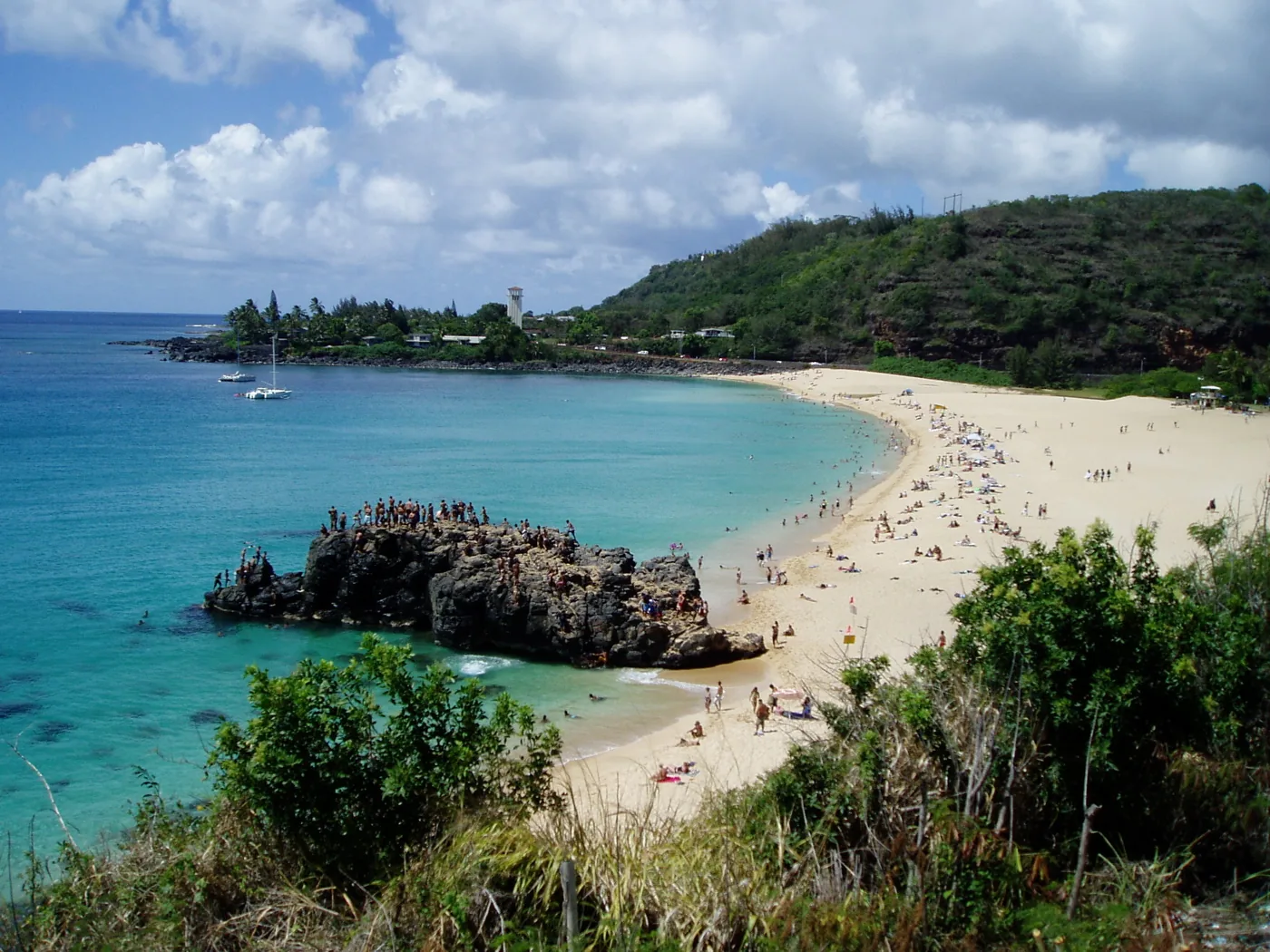
Why the change? Waimea is a deep, sandy bay open to the north-west, with little reef to break up incoming swell. In summer, when the North Pacific is quiet, nothing reaches it and the water lies flat. In winter, the biggest swells on the planet march straight in and break across the mouth of the bay, and the shorebreak on the sand becomes powerful enough to injure anyone standing in it.
Cost: free · Hours: lifeguards 8am–6:30pm · Lifeguard: yes, tower 29 · Parking: small lot, full by mid-morning · Bus: Route 60 · Allow: half a day in summer
6. Waimea Valley
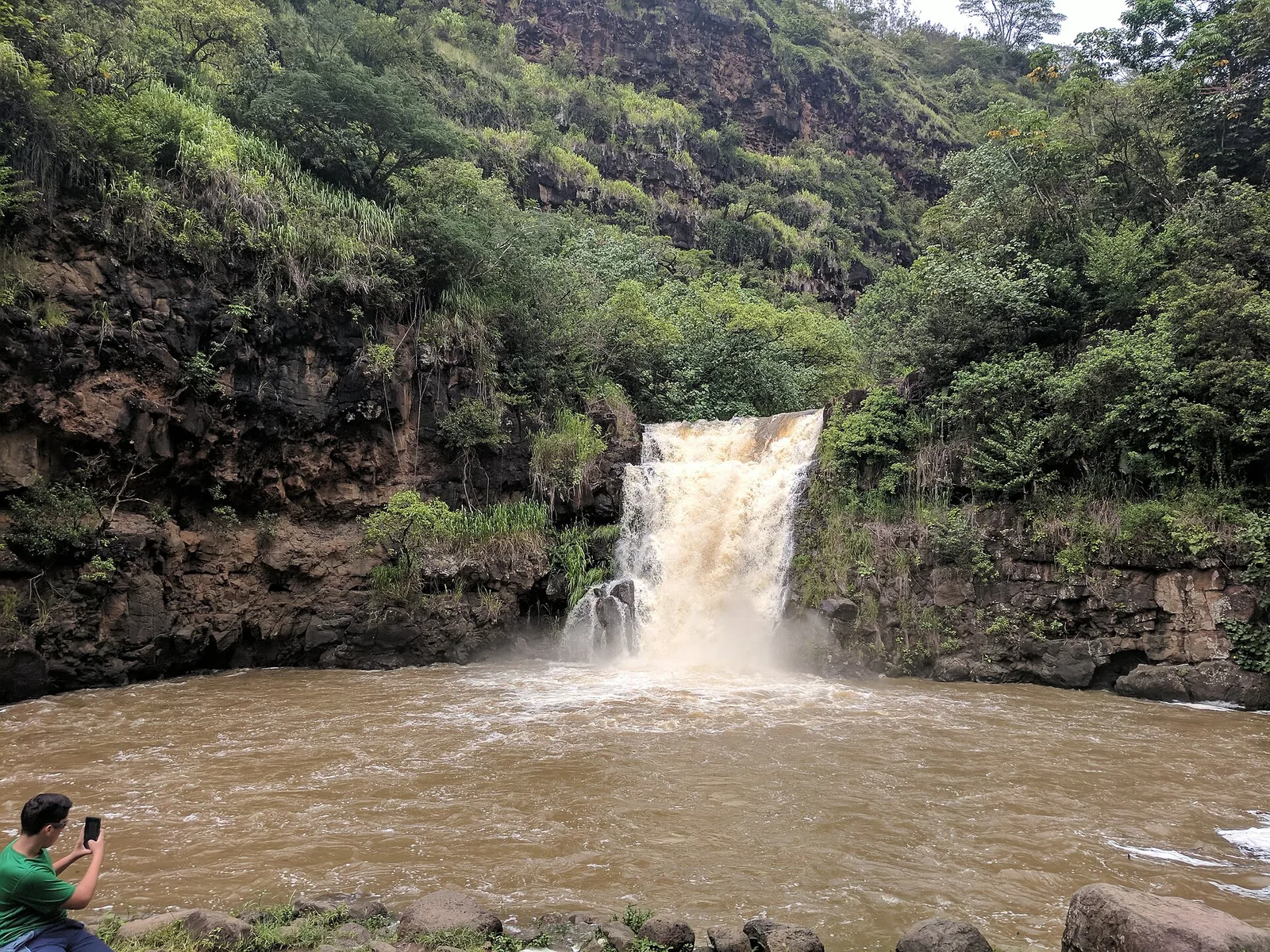
Across the highway from the bay, Waimea Valley is a botanical garden and cultural site in a lush valley that was sacred to Hawaiians for centuries. A paved path leads about three-quarters of a mile through the gardens, past restored archaeological sites, to Waimea Falls. Swimming in the falls pool is allowed only when lifeguards say so, decided each morning at 9am, and a life jacket is compulsory. After heavy rain the pool runs brown and swimming is closed. Entry is $26, and the valley is open from 9am to 4pm, Tuesday to Sunday. In the evenings, the Toa Lūʻau here starts at $125.
Cost: $26 · Hours: 9am–4pm, Tuesday–Sunday · Book: no · Bus: Route 60 · Allow: 2 hours
7. Puʻu o Mahuka Heiau
On the ridge above Waimea Bay, reached by a steep side road from the highway, is Puʻu o Mahuka, the largest heiau (temple) on Oʻahu and a state historic site. The low stone walls enclose a vast terrace with sweeping views along the coast. It’s a sacred place: stay on the paths, don’t climb the walls, and don’t move or stack stones, or leave anything behind.
Cost: free · Hours: daylight · Book: no · Allow: 30 minutes
8. Pūpūkea Beach Park and Sharks Cove
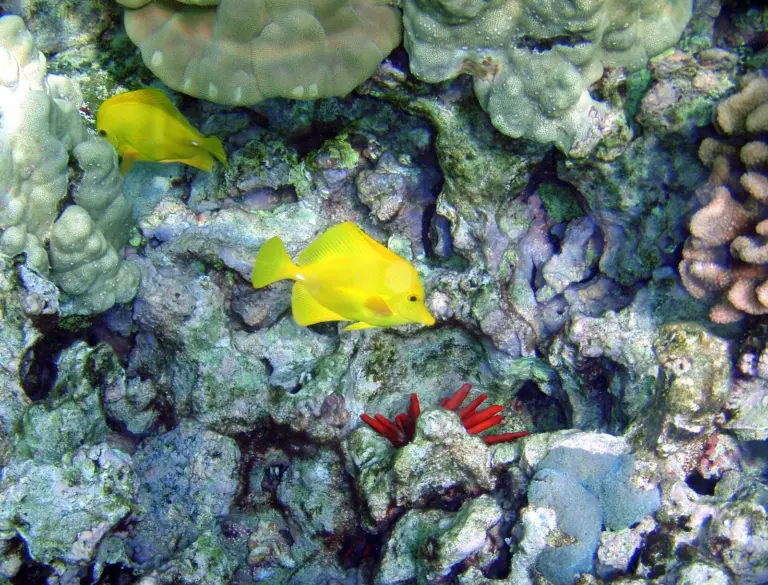
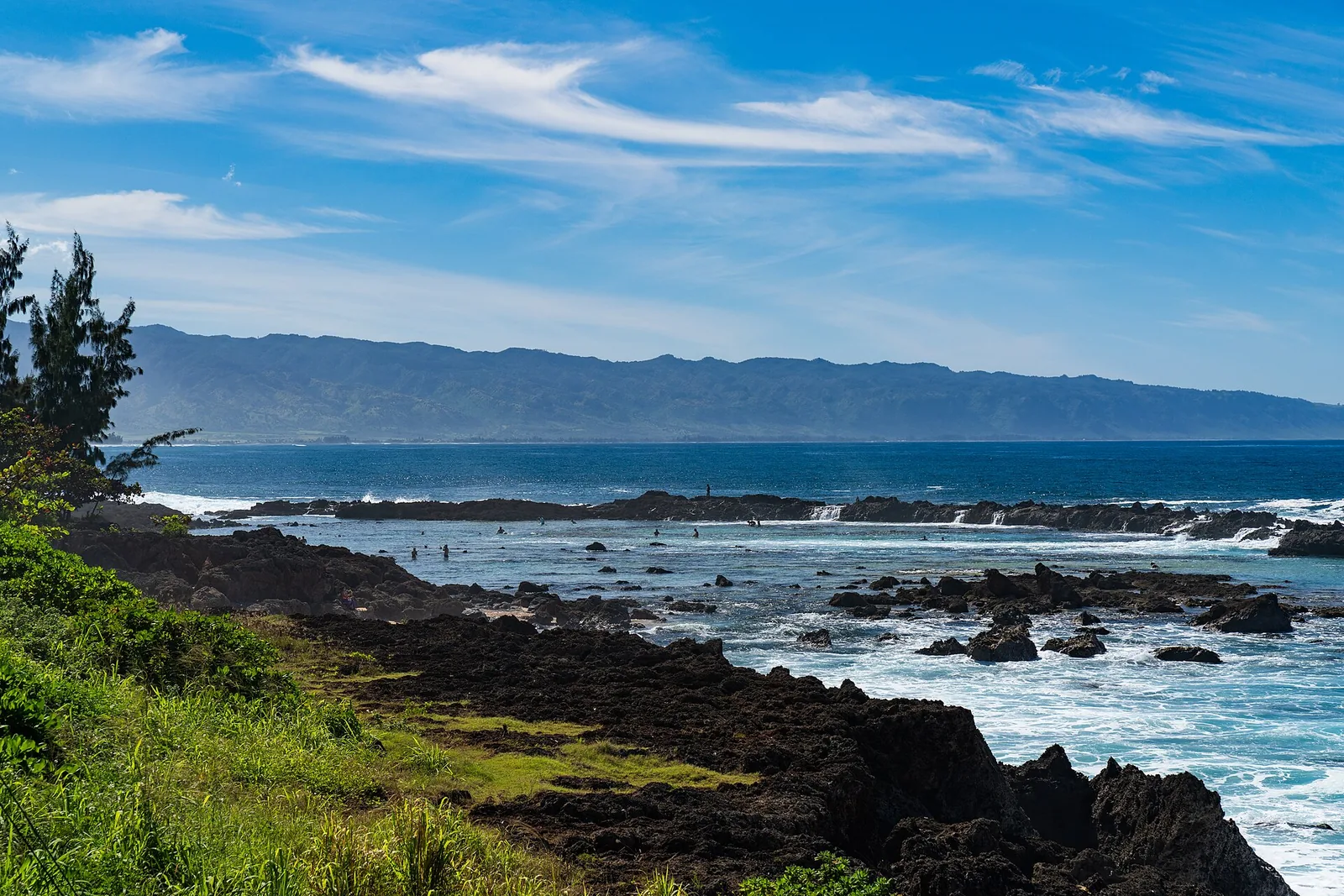
Inside the Pūpūkea Marine Life Conservation District, the lava-rock pools and reef at Sharks Cove offer the best shore snorkelling on the North Shore from about May to October. The name isn’t a warning; the fish are the attraction, along with the occasional turtle. In winter, surf sweeps across the rocks and pulls people off them, so stay well back. Wear reef shoes for the sharp lava, take nothing from the reserve and swim near lifeguard tower 28. Arrive before 9am in summer, when the water is calmest and the small car park still has space.
Cost: free · Lifeguard: yes, tower 28 · Parking: small lot, before 9am in summer · Bus: Route 60 · Allow: 2 hours
9. ʻEhukai Beach Park and the Banzai Pipeline
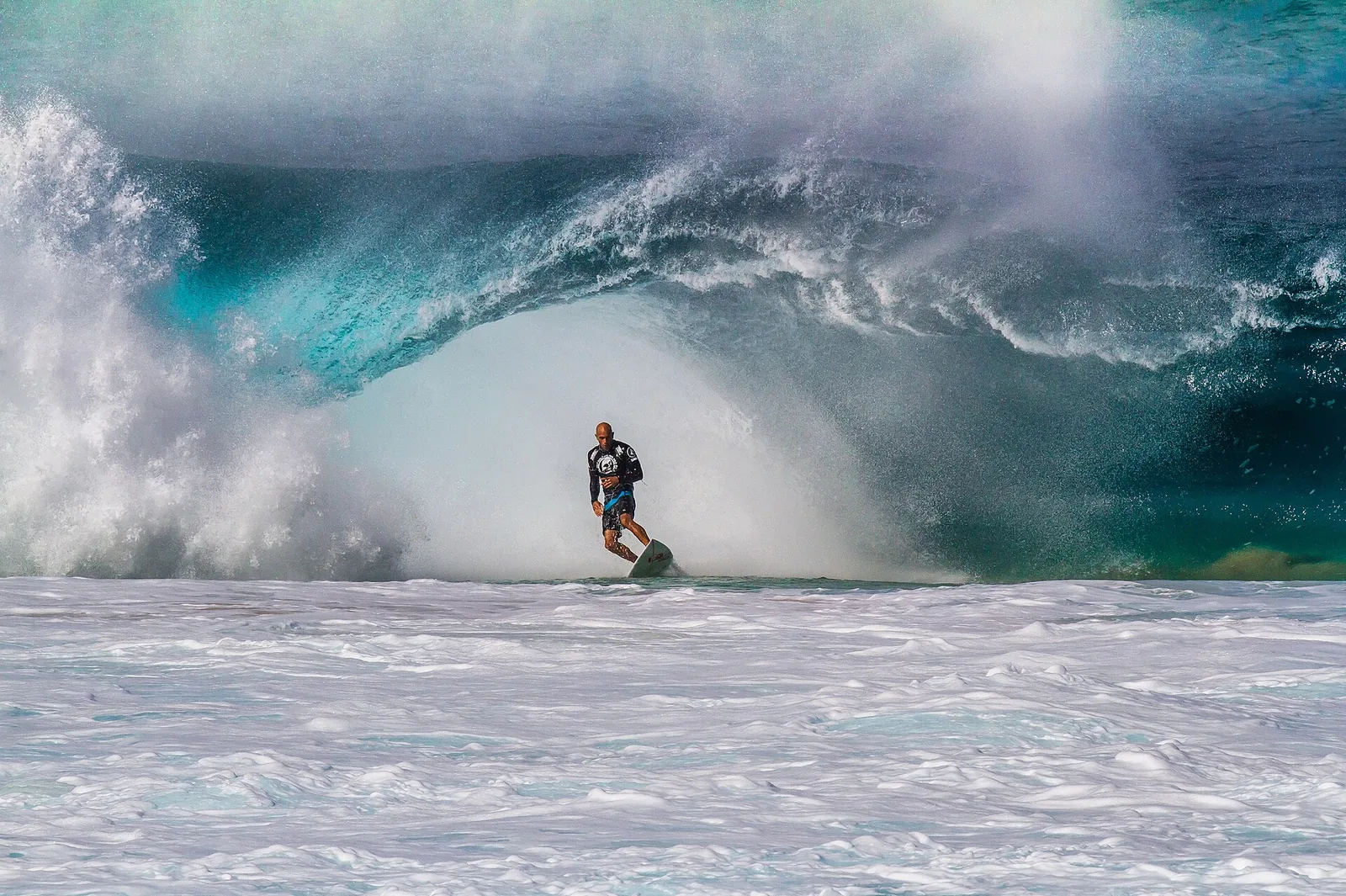
From November to March, Pipeline throws the most photographed waves on Earth onto shallow reef a short paddle from the sand. The best surfers in the world line up here, and watching them is free and unforgettable. The Lexus Pipe Masters has a waiting period from 8 to 20 December 2026; on contest days, park well away and walk along the beach. In summer, Pipeline goes flat and ʻEhukai becomes a quiet beach where you’d never guess what happens here in January.
What makes Pipeline so famous also makes it so dangerous. The wave breaks over a shallow ledge of lava reef only a few feet below the surface, close to shore, so it throws forward into a perfect tube and then slams onto rock. Even the best surfers in the world are injured here. Watch from the sand, and don’t be tempted to paddle out on a small-looking day.
Cost: free · Lifeguard: yes · Parking: small lot; roadside fills early in winter · Bus: Route 60 · Allow: 1–2 hours
10. Sunset Beach
Two miles of wide golden sand, with the sunset it’s named for. In summer it’s a gentle swimming beach; in winter it hosts some of the biggest surf on the island, with powerful rip currents. On big winter days, arrive before 8am or be prepared to walk from wherever you can legally park. It’s the best place on the North Shore to end the day.
Cost: free · Lifeguard: yes · Parking: beach park lot and roadside · Bus: Route 60 · Allow: 1–2 hours
11. Turtle Bay and Kuilima Cove
At the island’s northern tip, the Turtle Bay resort sits on its own point, with coastal trails, horse riding and, beside the hotel, Kuilima Cove, a small bay sheltered by reef and one of the few North Shore spots with calm water for much of the year. It’s excellent for children and beginner snorkellers in summer. The resort is also the only resort-zoned area on the North Shore, so it’s the one place you can legally stay for a few nights without a long-term rental.
Cost: free beach access · Lifeguard: check · Parking: public access through the resort · Bus: Route 60 · Allow: 2 hours
12. The Kahuku shrimp trucks
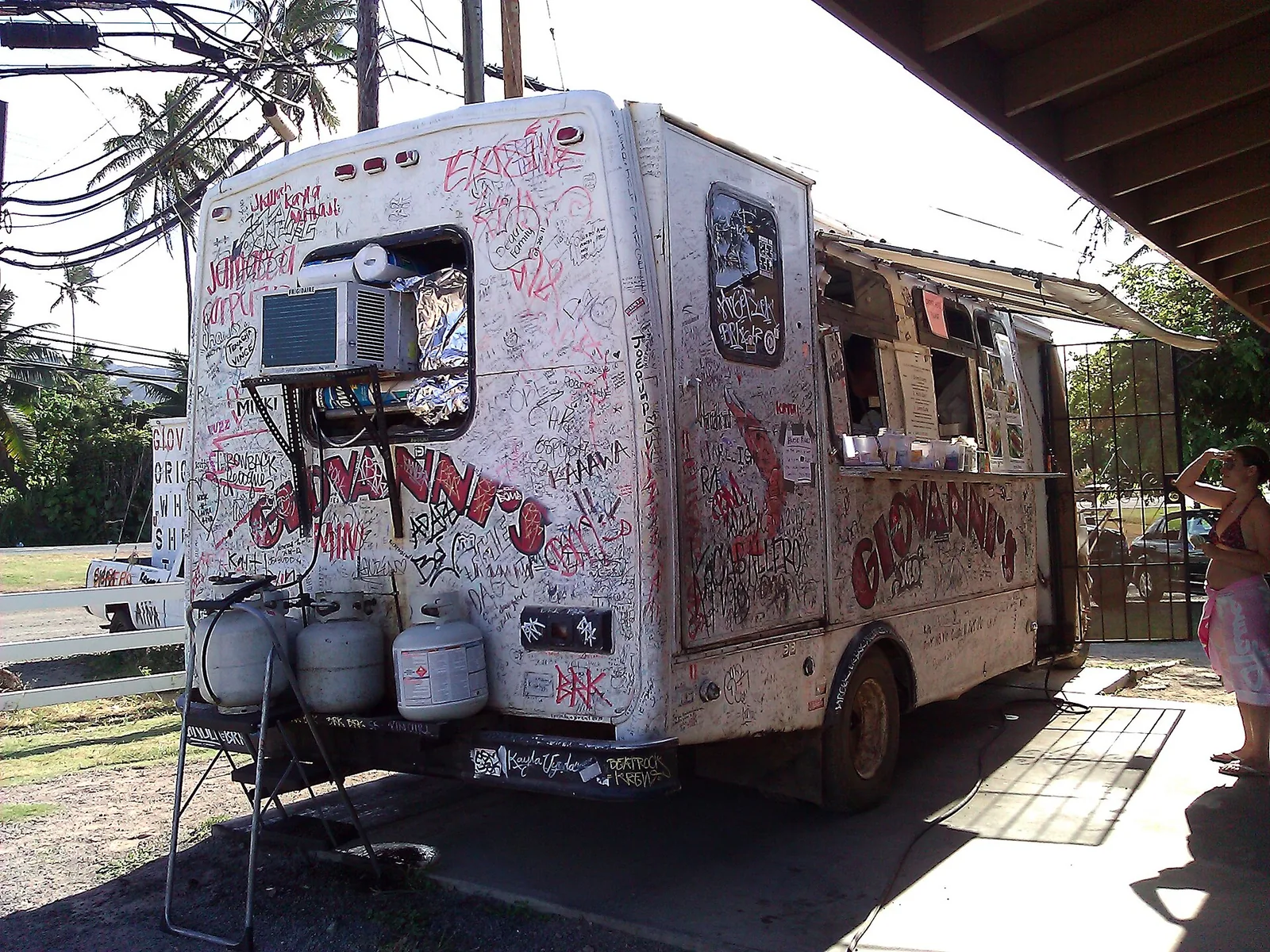
Kahuku is known for its aquaculture farms, and a string of shrimp trucks and stands lines the highway through town. A garlic shrimp plate here is one of the rituals of a North Shore day. Giovanni’s graffiti-covered truck is the most famous: a garlic shrimp plate costs $14, and the Kahuku truck opens Monday to Friday from 10:30am to 6:30pm. Romy’s, nearby, serves plates of prawns from its own farm for under $20. Expect queues at lunchtime, and have a napkin ready.
These are local-style dishes, the product of Hawaiʻi’s plantation-era mix of cultures, not traditional Hawaiian food. They’re delicious, and they’re part of the North Shore’s character.
Cost: shrimp plates from $14 · Hours: Giovanni’s Kahuku Mon–Fri 10:30am–6:30pm; Haleʻiwa daily 10:30am–5pm · Bus: Route 60 · Allow: 45 minutes
13. The Polynesian Cultural Center
Ten minutes past Kahuku in Lāʻie, the Polynesian Cultural Center recreates six Polynesian villages and is consistently rated Oʻahu’s top paid attraction. It opens from noon to 9pm and is closed on Sundays and Wednesdays. Villages entry is $94.95, and the Aliʻi Lūʻau package is $197.95. A coach from Waikīkī costs $28 if you’re not driving. It makes a long day, so many visitors combine it with an easy morning on the North Shore rather than a full beach day.
Cost: from $94.95 · Hours: noon–9pm; closed Sunday and Wednesday · Book: ahead · Bus: Route 60; coach $28 · Allow: an afternoon and evening
14. Mokulēʻia and Kaʻena Point
West of Haleʻiwa, the road runs out along the Mokulēʻia coast towards Kaʻena Point, the island’s westernmost tip. The beaches here are long, empty and windy, with dangerous winter surf and no lifeguards. The old airfield at Kawaihapai is home to gliders and skydiving, with Skydive Hawaii charging $198 online or $245 walk-in. Kaʻena Point itself is reached on foot along an old dirt road, about 2.5 miles each way, with no shade or water, to a fenced reserve where Laysan albatross nest and monk seals rest on the sand. In Hawaiian tradition it’s a leina, a place where souls leap into the afterlife, so treat it with respect. After Hurricane Lowell, the Mokulēʻia permit gate area is closed; check with State Parks before you drive out.
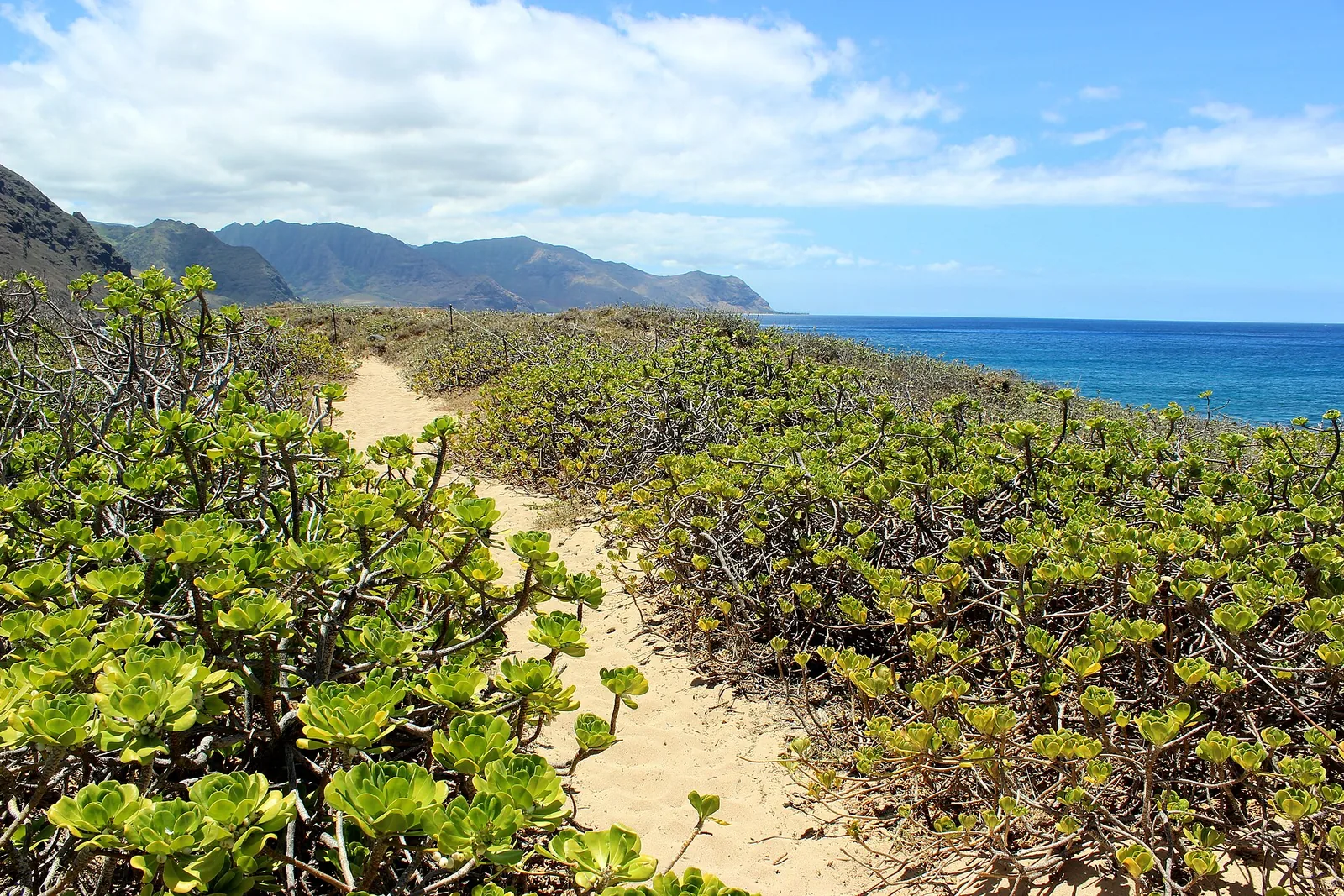
Cost: free; skydiving from $198 · Lifeguard: no · Book: skydiving ahead · Allow: half a day for Kaʻena on foot
Where to eat on the North Shore
North Shore food is casual, outdoors and mostly served from trucks, stands and counters. That’s the fun of it.
- Shrimp trucks: Giovanni’s in Kahuku and Haleʻiwa, $14 for a garlic plate, and Romy’s in Kahuku, under $20. Go before noon or after 2pm to beat the longest queues.
- Shave ice: Matsumoto’s in Haleʻiwa, open 10am to 6pm, is the classic; get it with ice cream underneath and sweet azuki beans if you’re adventurous.
- Farmers market: the Haleʻiwa Farmers Market on Thursdays from 3pm to 7pm, for tropical fruit, local snacks and crafts.
- Fruit stands: roadside stands along the highway sell papaya, pineapple and apple bananas; buy from farmers where you can.
- Lūʻau: the Toa Lūʻau at Waimea Valley from $125, or the Aliʻi Lūʻau at the Polynesian Cultural Center as part of a $197.95 package.
Plate lunch, garlic shrimp and shave ice are local-style food, shaped by the Japanese, Chinese, Filipino, Portuguese and Korean workers who came to the plantations. Traditional Native Hawaiian food means dishes like kālua pig, laulau and poi, which you’ll find at a lūʻau.
Parking on the North Shore
Parking decides more North Shore days than the weather. These are the realistic windows.
| Stop | Parking | Arrive by |
|---|---|---|
| Waimea Bay | Small beach park lot | 9am in summer; earlier on big winter days |
| Sharks Cove | Small lot across the road | 9am in summer |
| Laniakea | Limited; changing with roadworks | Follow current signs; never the highway shoulder |
| Pipeline (ʻEhukai) | Small lot and roadside | 8am on winter swell and contest days |
| Sunset Beach | Beach park lot and roadside | 8am on big winter days |
| Haleʻiwa town | Shopping centre and street parking | Before noon |
| Turtle Bay | Public access through the resort | Mid-morning |
Two rules apply everywhere. Never park illegally or on the highway shoulder; tickets and towing are enforced, and it’s dangerous on a narrow two-lane road. And leave nothing in the car: break-ins at North Shore beach car parks are common, and rental cars are easy to spot.
Watching and learning to surf
The North Shore’s winter surf is one of the great natural spectacles, and you don’t need to be a surfer to enjoy it. On a big day at Pipeline, you’ll see the world’s best riders disappear into barrels a few hundred yards away. At Waimea Bay, the waves can be the size of houses. Bring binoculars, find a spot on the sand well back from the water, and stay out of the ocean: the shorebreak on big days can knock you down and drag you in.
If you want to learn to surf, the North Shore in winter is the wrong place. Waikīkī’s gentle, rolling waves are ideal for beginners all year, with group lessons from $95; see our guide to Waikīkī Beach. In summer, when the North Shore goes flat, Haleʻiwa has gentle waves suitable for lessons too.
The North Shore with children
Children love the North Shore, as long as you plan around the water. In summer, Kuilima Cove at Turtle Bay and Haleʻiwa Beach Park are the gentlest swims, and Waimea Bay is superb on calm days with a lifeguard watching. In winter, keep them on the sand and make the day about turtles, trains and shave ice instead. The Dole Plantation’s pineapple train, $15, and its maze, $10, are a good first stop on the way up. At Waimea Valley, the $26 garden walk is stroller-friendly, and the falls swim, when lifeguards allow it, comes with a compulsory life jacket. Laniakea’s turtles are a highlight at any age, as long as everyone understands the 10-foot rule. Pack snacks and water, as queues for food can be long, and plan a rest in the middle of the day.
The North Shore on a budget
The North Shore is one of the cheapest good days out on Oʻahu. Every beach is free, and so are Laniakea’s turtles, the surf at Pipeline and the views from Puʻu o Mahuka Heiau. Take TheBus Route 60 for $3.25 a ride, or $7.50 for the whole day on a HOLO card, and eat from the trucks: a garlic shrimp plate at Giovanni’s is $14, and the Thursday farmers market in Haleʻiwa has cheaper local food still. If you pay for one thing, make it Waimea Valley at $26. Skip the Dole Plantation unless you have children.
A rainy day on the North Shore
Rain on the North Shore often comes in short showers that pass within the hour, so wait it out in Haleʻiwa’s galleries, surf shops and cafés before giving up on the day. Waimea Valley is lovely in light rain, with the gardens at their greenest, though the falls close to swimmers when the water turns brown. After heavy rain, stay out of the sea for 72 hours, because runoff carries sewage and bacteria, and keep off the ridges and valley trails, which turn slippery and can flood fast. If the whole island is wet, the leeward coast around Ko Olina is usually the driest place to go.
What to pack for a North Shore day
- Reef shoes for the lava rock at Sharks Cove and the rocky entries elsewhere.
- Mineral sunscreen and a hat. There’s little shade on most beaches, and oxybenzone and octinoxate sunscreens are banned.
- Snorkel gear that fits, in summer. Test it in shallow water before you swim out.
- Binoculars, in winter, for the surf at Pipeline and Waimea Bay.
- Water, snacks and a little cash. Queues for food can be long, and some roadside fruit stands only take cash.
- A towel, a change of clothes and a bag for rubbish, since bins are scarce and often full.
Where to watch the sunset
The North Shore faces north-west, so the sun sets over the ocean for much of the year. Sunset Beach lives up to its name, with a long, open horizon and, in winter, surfers silhouetted on the waves. The lookout above Waimea Bay and the grass at Haleʻiwa Aliʻi Beach Park are good alternatives. If you stay for sunset, plan to drive home after dark rather than joining the afternoon traffic, and eat dinner in Haleʻiwa while the roads clear.
Getting to the North Shore
By car
The quickest route from Waikīkī is the H-1 and the H-2 through the middle of the island, then down to Haleʻiwa: about an hour in normal traffic. Leave by 7:30am to beat the commuter traffic and the crowds, and head home by 3pm or after dark. The alternative is the windward route along the coast, via Kailua and Kualoa, which is slower but far more scenic, and makes the drive part of the day. If you’re flying home the same day, Pearl Harbor sits right on the H-1 on the way back to the airport; our Pearl Harbor visitor guide covers the bag storage and ticket times.
By bus
TheBus Route 60 runs from Ala Moana Center through Kāneʻohe and along the windward coast to the North Shore and Haleʻiwa. From the North Shore back to Ala Moana takes about 1 hour 14 minutes by the timetable, and longer in traffic. A single fare is $3.25, or use a HOLO card, which caps what you pay at $7.50 a day. Route 52 runs from Honolulu to Wahiawā only.
By tour
Circle-island tours from Waikīkī cover the North Shore in a day with stops at the main beaches and the shrimp trucks. They’re a good option if you don’t want to drive, but they spend a lot of time on the road and rarely let you swim. The Polynesian Cultural Center’s own coach from Waikīkī costs $28.
Staying on the North Shore
A night or two on the North Shore lets you see it at sunrise and sunset, without the crowds or the drive. Options are limited. Turtle Bay is the only resort-zoned area, so it’s the only place where short stays are straightforward. Elsewhere, in Haleʻiwa and along Sunset Beach, holiday rentals of under 30 days are legal only if the owner holds a city Nonconforming Use Certificate, so check for the certificate number before you book. For the full picture, see our guide to where to stay in Oʻahu.
A short history of the North Shore
Long before surfers arrived, the North Shore was farming and fishing country. Waimea Valley was home to generations of kahuna, and Puʻu o Mahuka Heiau, the island’s largest temple, looks down on the bay. In the 19th and 20th centuries, sugar and pineapple plantations covered the land behind the coast, and the Waialua Sugar Mill near Haleʻiwa operated until 1996. At the end of the 19th century, the Oʻahu Railway ran all the way around to Haleʻiwa, where the grand Haleiwa Hotel opened in 1899 for day-trippers from Honolulu.
Surfing put the North Shore on the world map from the 1950s and 1960s, when big-wave pioneers began riding Waimea Bay, and it has been the centre of professional surfing’s winter season ever since. The late Eddie Aikau, a Waimea Bay lifeguard and big-wave surfer, is remembered in the contest that bears his name and in the local saying “Eddie would go”. Today, the North Shore remains a close-knit community, proud of its rural character and wary of overdevelopment. Visitors are welcome; treat it as a neighbourhood, not a theme park.
Respecting the North Shore community
“Keep the Country Country” is a phrase you’ll see on signs and bumper stickers all along the North Shore, and it sums up how many residents feel. This is a rural community of surfers, farmers and families who have watched visitor numbers, traffic and development grow for decades. A few simple habits make a big difference.
- Drive with patience. Kamehameha Highway is a two-lane road through neighbourhoods. Let people out, give a shaka, and pull over safely if you want to look at the surf.
- Park legally. Don’t block driveways, stop on the shoulder or park on lawns.
- Respect the surf line-up. The big breaks are for experienced local surfers. If you’re not one, don’t paddle out.
- Buy local. Fruit stands, food trucks and independent shops keep money in the community.
- Take nothing, leave nothing. Don’t remove lava rock, sand, shells or coral, don’t stack stones, and take your rubbish home.
- Keep drones away from homes, heiau and wildlife.
Staying safe on the North Shore
Drowning is the leading cause of injury death among visitors to Hawaiʻi, and the North Shore in winter is one of the most dangerous stretches of coast on the islands. These rules matter.
- Check the season. From November to March, treat every North Shore beach as a place to watch, not swim, unless a lifeguard tells you otherwise.
- Talk to the lifeguard. Towers at Waimea, Sharks Cove, Pipeline, Sunset and Haleʻiwa Aliʻi are staffed from 8am to 6:30pm.
- Stay off wet rocks. At Sharks Cove and around the headlands, waves sweep across the rocks and pull people in.
- Skip the Waimea rock jump. People are hurt there every year.
- Know your rip currents. If you’re caught, don’t fight it: swim parallel to the shore, or float and signal for help.
- Stay out after heavy rain for 72 hours, and while any brown-water advisory is posted.
- Give wildlife space. Keep 10 feet from turtles and 50 feet from monk seals, or 150 feet from a mother and pup.
- Respect closures and kapu. Signs marked kapu or no trespassing mean exactly that: don’t enter.
For every beach on the island, rated for summer and winter, see our guide to the best beaches in Oʻahu, and for how the North Shore fits into a week, our Oʻahu itinerary. For the rest of the island, see our list of things to do in Oʻahu.
For the ʻEhukai Pillbox, the Kaunala Loop and other trails above the North Shore, see our full guide to Oʻahu hikes.
If you would rather be driven, or want to add a lūʻau at Waimea Valley or the Polynesian Cultural Center, our guide to Oahu tours compares prices, what is included and which are worth it.
Frequently Asked Questions
Is the North Shore Oahu worth visiting?
Yes. It’s the best day out on Oʻahu for most visitors: calm swimming and snorkelling in summer, world-famous surf in winter, turtles at Laniakea, Waimea Valley and the Kahuku shrimp trucks. Allow a full day, start early to beat the traffic and parking crunch, and plan your stops around the season.
Can you swim on the North Shore in winter?
Usually not. From roughly November to March, big swells bring powerful waves, shorebreak and rip currents to Waimea Bay, Sharks Cove, Pipeline and Sunset Beach. Watch from the sand, and ask a lifeguard before going in anywhere. In summer, from about May to October, the same beaches are often calm and excellent for swimming.
How long is the drive from Waikīkī to the North Shore?
About an hour via the H-1 and H-2 in normal traffic, longer at rush hour or on big-surf days. The scenic windward route, via Kailua and the coast, takes longer. TheBus Route 60 runs from Ala Moana, with the journey back taking about 1 hour 14 minutes by the timetable.
When is the best time to see turtles at Laniakea?
Turtles are most often on the sand between about 11am and 2pm, when they come ashore to rest and warm up, and summer gives the best odds. Volunteers rope off a 10-foot zone around resting turtles. Never touch or feed them, and never park on the highway shoulder.
How much is a shrimp plate on the North Shore?
A garlic shrimp plate at Giovanni’s costs $14. Giovanni’s Kahuku truck is open Monday to Friday from 10:30am to 6:30pm, and its Haleʻiwa truck daily from 10:30am to 5pm. Romy’s in Kahuku serves plates for under $20. Go before noon or after 2pm to avoid the longest queues.
When is the Pipe Masters in 2026?
The Lexus Pipe Masters has a waiting period from 8 to 20 December 2026. The contest runs only on days when the surf is good enough, so the exact dates are decided at short notice. Watching from the sand is free; on contest days, arrive early, park legally well away and walk along the beach.
Can you stay on the North Shore?
Yes, but options are limited. Turtle Bay is the only resort-zoned area, so it’s the one place where short stays are straightforward. Elsewhere, rentals of under 30 days need a city Nonconforming Use Certificate to be legal. Staying a night or two lets you see the North Shore at sunrise and sunset without the traffic.
Is Waimea Valley worth it?
Yes, especially in winter when the beaches are for watching. The $26 entry covers a garden walk of about three-quarters of a mile through a culturally important valley to Waimea Falls. Swimming in the falls is allowed only when lifeguards approve, decided at 9am, with a compulsory life jacket. It’s open 9am to 4pm, Tuesday to Sunday.
Photo Credits
- Banzai Pipeline (featured): Fosterand sons, CC BY-SA 4.0
- Map: honolulutourism.org; coastline data © OpenStreetMap contributors, ODbL
- Anahulu bridge, Haleʻiwa: rjones0856, CC BY 2.0
- Liliʻuokalani Protestant Church: Ken Lund, CC BY-SA 2.0
- Sea turtles at Laniakea Beach: BjL1504, CC BY-SA 4.0
- Waimea Bay: Travisthurston, CC BY-SA 3.0
- Waimea Falls: shanstap, CC BY-SA 4.0
- Sharks Cove, Pūpūkea: Tony Webster, CC BY 2.0
- Giovanni’s shrimp truck: Don Ramey Logan, CC BY-SA 3.0
- Matsumoto Shave Ice: Priya Deonarain, CC BY-SA 2.0
- Kaʻena Point trail: Aaron Zhu, CC BY-SA 3.0